How to Bet on Greyhounds: Step-by-Step for UK Punters
 Available in US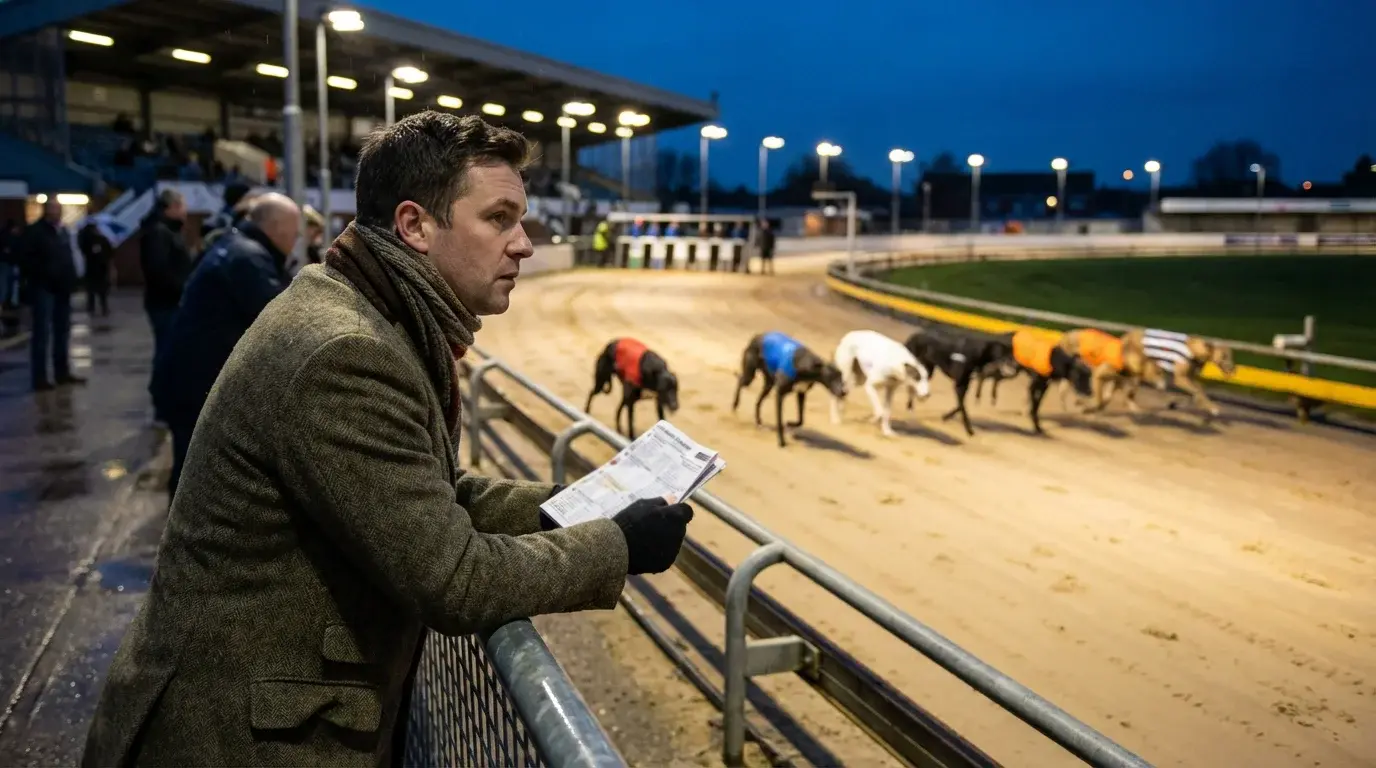
Your First Greyhound Bet Doesn’t Have to Be a Guess
Most people’s first greyhound bet is a stab in the dark — this guide turns the lights on.
There is a particular kind of confidence that comes from walking into a betting scenario where you understand the mechanics, the vocabulary and the rhythm of what you’re watching. Greyhound racing in the UK offers that opportunity more readily than almost any other betting medium. Six dogs, a fixed distance, a race that lasts around 30 seconds. No jockeys making tactical decisions mid-race, no draw biases hidden behind fifteen-runner handicaps. The variables are fewer, the data is more accessible, and the racing happens with a frequency that gives you dozens of chances to learn in a single evening.
For a UK punter stepping into greyhound betting for the first time, the landscape can still feel opaque. Racecards look dense. Trap statistics feel like someone else’s homework. Terms like BAGS, BOG and SP get thrown around as if everyone already knows. And the sheer volume of daily racing — sometimes 80 or more races across licensed tracks — can feel less like opportunity and more like noise.
This guide strips that back. It walks through everything from opening a betting account to placing your first win bet, reading a racecard with actual comprehension, understanding what the odds are telling you, and eventually moving into forecasts and accumulators when the basics feel solid. It does not assume you know the difference between a straight forecast and a combination tricast. It does assume you are willing to do the small amount of preparation that separates a considered bet from a random one.
Greyhound betting in the UK sits at an interesting point in 2026: live streaming is widely available through bookmakers, BAGS and BEGS meetings run throughout the day, and data coverage has improved enough that even casual punters can access form, sectional times and trap statistics without a subscription. The barrier to entry has never been lower. The question is whether you walk through it informed or not.
Understand how odds work in greyhound betting odds work.
Setting Up: Account, Deposit and Finding the Dogs
Step one isn’t picking a dog — it’s picking a platform that doesn’t bury greyhound racing three clicks deep.
Not every bookmaker gives greyhound racing equal billing. Some treat it as a sidebar to football and horse racing, tucking meetings into a submenu where you need to know exactly what you’re looking for. Others surface greyhound cards prominently, with integrated racecards, live streaming and dedicated promotions. Before you deposit a penny, it is worth spending five minutes navigating the greyhound section of any site you are considering. If the interface makes it difficult to find today’s meetings, compare odds across races, or access basic form data, that is a signal about how seriously the platform takes the sport.
What you are looking for at this stage is straightforward: a licensed UK bookmaker with coverage of BAGS and BEGS meetings, live streaming on at least the major cards, and ideally best odds guaranteed on greyhound racing. BOG means that if you take an early price and the starting price drifts higher, you get paid at the better number. It is one of the most punter-friendly features available and not all bookmakers extend it to greyhounds, so checking this upfront saves frustration later.
Beyond the platform itself, the daily rhythm of UK greyhound racing is worth understanding before you place anything. BAGS meetings — races funded by the Bookmakers’ Afternoon Greyhound Service — typically run from late morning through the afternoon, providing the bulk of daytime racing available online. BEGS meetings, funded through the evening equivalent scheme, cover the traditional evening cards. On a busy day, there may be meetings running simultaneously at Romford, Crayford, Nottingham, Monmore and several other licensed tracks. You do not need to follow all of them. In fact, starting with one or two tracks and learning their quirks is a far better approach than scattergun betting across every meeting on the card.
How to Open a Betting Account for Greyhound Racing
Opening an account with a UK-licensed bookmaker follows a standard process regardless of whether you plan to bet on greyhounds, football or horse racing. You will need to provide your name, date of birth, address and contact details. Under UK Gambling Commission rules (Gambling Commission), every operator must verify your identity before allowing you to withdraw funds — and most now require verification before you can deposit or bet at all. This typically means uploading a photo of your passport or driving licence and a recent utility bill or bank statement.
The verification process — known as KYC, or Know Your Customer — can take anywhere from a few minutes to 24 hours depending on the operator. Some use automated document-scanning services that approve you almost instantly; others route applications through manual review. It is worth completing this step before the evening you intend to bet, rather than discovering at 7pm that your account is locked pending a document check.
During registration, you will also be prompted to set responsible gambling limits. These typically include deposit limits, loss limits and session time reminders. Setting reasonable limits at the outset is sensible practice regardless of experience level, and adjusting them later takes a cooling-off period of at least 24 hours for reductions.
How to Navigate to Greyhound Markets Online
Once your account is live and funded, finding greyhound markets depends heavily on which bookmaker you are using. Most major operators have a dedicated “Greyhounds” tab in their main navigation, sometimes labelled “Dogs” or grouped under “Racing” alongside horse racing. Clicking through should bring up a list of today’s meetings, sorted by time or by track.
The most useful view at this point is “Next Off” — a feature showing the next race about to start across all tracks. This gives you a quick sense of the daily schedule without having to navigate track by track. For a more considered approach, select a specific meeting, open the full racecard for a race 20 or 30 minutes out, and give yourself time to read the form before the market closes.
If your bookmaker offers ante-post markets on major events — the English Greyhound Derby, the St Leger and similar — these are usually found under a separate “Ante-Post” or “Futures” tab within the greyhound section. You will not need ante-post markets as a beginner, but knowing they exist is useful once you start following specific dogs or trainers across a season. For now, your focus should be on individual race cards from BAGS and BEGS meetings, where the action happens daily and the learning curve is steepest.
Placing Your First Bet: Win, Place and Each Way
Win is the simplest bet you can make — and it teaches you more about greyhound racing than any guide.
A win bet does exactly what the name suggests: you pick a dog, and if it finishes first, you get paid. The payout is determined by the odds at the time of settlement — either the price you locked in when you placed the bet (a fixed-odds or early price bet) or the starting price, which is the final market price at the moment the traps open. If you took an early price and your bookmaker offers best odds guaranteed on greyhounds, you receive whichever price is higher.
The practical process of placing a win bet online takes less than a minute. Open a racecard for a race that has not yet started. Each dog is listed with a trap number (1 through 6), its name, recent form, and current odds. Tap or click the odds next to the dog you want to back for a win. This adds the selection to your bet slip. Enter your stake — this is the amount you are risking, not the total potential return. Confirm the bet. That is it.
A place bet works similarly, except your dog needs to finish in the top two rather than winning outright. Place odds are typically a fraction of the win price — in six-runner greyhound races, the standard term is one-quarter of the win odds for the first two places. So if a dog is priced at 8/1 to win, the place part pays 2/1. This matters because the place element forms the backbone of each-way betting.
An each-way bet is two bets in one: a win bet and a place bet at equal stakes. If you place £5 each way on a dog at 8/1, you are staking £10 in total — £5 on the win at 8/1 and £5 on the place at 2/1. If the dog wins, both bets pay out. If it finishes second, you lose the win part but collect on the place. Each-way betting is popular with greyhound punters because the six-runner fields mean every dog has a realistic chance of placing, which cushions your downside on longer-priced selections.
For a first bet, a straightforward win single on a dog whose recent form you have actually looked at is the right call. Resist the temptation to load up a complicated multi-leg wager before you understand the basics. Watch how the odds move in the minutes before a race. See whether your dog’s price shortens or drifts. Notice how the racecard comments align — or fail to align — with what happens once the traps open. This is where the education starts, and a simple win bet gives you the clearest line of sight into that process.
Making Sense of Greyhound Odds Before You Bet
Odds tell you what the market thinks — not what will happen.
In UK greyhound racing, odds are traditionally displayed in fractional format: 5/1, 7/2, 11/4 and so on. A dog at 5/1 returns £5 for every £1 staked, plus your stake back, if it wins. Decimal odds, more common on betting exchanges and European-facing platforms, express the same thing differently — 5/1 becomes 6.00, meaning your total return on a £1 stake is £6. Neither format is inherently better; it is simply a question of what you are used to reading quickly. Most UK bookmakers let you toggle between formats in your account settings.
What matters more than the format is understanding the difference between early price and starting price. An early price is a fixed-odds quote available in the hours or minutes before a race. It is a contract: you accept those odds, and the bookmaker honours them regardless of how the market moves afterwards. The starting price — SP — is the final consensus odds at the moment the traps open, calculated from the on-course and off-course market. If you do not lock in an early price, your bet is settled at SP.
The tactical question is when to take the price and when to let it ride to SP. Early prices carry value when you believe the market has underestimated a dog — perhaps you have noticed a kennel in strong form or a favourable trap draw that the wider market has not yet priced in. But early prices can also be traps of their own kind: if a dog’s price shortens between the early show and the off, taking the early number meant you got the best of it. If it drifts, SP would have paid better. This is where best odds guaranteed earns its place in the conversation. With BOG, you take the early price but receive the SP if it turns out to be higher. Not every bookmaker offers BOG on greyhounds, and among those that do, some restrict it to BAGS meetings only. Checking the terms before you bet avoids unpleasant surprises.
One layer beneath the odds themselves sits the bookmaker’s margin — also called the overround. In a perfectly fair six-dog race, the implied probabilities of all runners would add up to 100%. In practice, they add up to somewhere between 115% and 130%, depending on the bookmaker and the market. That gap is the bookmaker’s built-in profit. Lower overrounds mean better value for the punter. Comparing the same race across two or three bookmakers occasionally reveals meaningful differences, particularly on forecast and tricast dividends where margins tend to be wider and less transparent.
Moving Beyond Win Bets: Forecasts, Tricasts and Multiples
Once you’ve placed enough win bets to understand the rhythm of a meeting, forecasts start making sense.
A straight forecast asks you to predict the first and second dog in the correct order. A reverse forecast covers both possible finishing orders — your two selections in either first or second place — and costs twice the stake of a straight forecast as a result. A combination forecast allows you to select three or more dogs and covers every possible first-and-second pairing among them. The more dogs you include, the more individual bets are generated and the higher the total stake, but you are also casting a wider net across a race where the outcome is genuinely uncertain.
Forecasts are where greyhound betting begins to reward analysis. Picking a winner is one dimension; identifying the likely first-second combination requires a deeper read of the racecard. You need to think about running styles — which dogs are early-pace types likely to lead out of the first bend, and which are closers who finish strongest over the final stretch. A race with one obvious front-runner and one obvious closer often produces a more predictable forecast than a race where three or four dogs run the same style and are likely to interfere with each other at the first turn.
Tricasts take this a step further, asking you to predict the first three home in exact order (straight tricast) or in any order among your selections (combination tricast). The payouts can be dramatic — tricast dividends of £200 to £500 from a £1 stake are not unusual in competitive six-dog fields — but the hit rate is correspondingly low. Tricasts are inherently high-variance bets, and treating them as a regular staking method rather than an occasional calculated shot tends to erode your bankroll quickly.
Multiple bets — accumulators, doubles, trebles and beyond — combine selections from different races into a single wager. The appeal is obvious: each winning leg multiplies into the next, producing returns that dwarf what you would achieve from singles. A four-fold accumulator on four dogs at 3/1 each returns £256 from a £1 stake if all four win. The catch is equally obvious. One loser kills the entire bet. With greyhound favourites winning roughly 30 to 35 percent of races, the probability of stringing together four consecutive winners falls off sharply with each added leg.
When to Place a Forecast Bet
The strongest forecast scenarios arise when you can identify a likely winner but are less certain about which dog finishes second — or, conversely, when you believe two specific dogs will dominate a weak field without being sure which one prevails. In the first case, a reverse forecast covering your top pick in either first or second with a strong secondary selection gives you coverage without ballooning your stake. In the second, a straight forecast on the pairing you consider most probable, supported by a reverse on the same two dogs at half-stake, creates a layered position where you profit handsomely if you nail the order and still collect if you get the pairing right but reversed.
Graded racing provides particularly fertile ground for forecasts. In a standard A4 or A5 race, the field is tightly matched by recent performance, which means one or two dogs with a clear advantage in trap draw or sectional times can stand out against a competitive but predictable pack. Open races and puppy stakes, where the form lines are thinner and the grading less reliable, tend to produce more chaotic outcomes that make forecasts harder to land.
One practical rule worth adopting early: never place a forecast unless you have a specific reason to believe the first two places are more predictable than usual. If you cannot articulate why two particular dogs should fill the top two spots, a win single on your strongest fancy is a cleaner bet with a higher expected hit rate.
Building Your First Greyhound Accumulator
An accumulator across greyhound races works identically to one on football or horse racing: each selection must win for the bet to pay out, and the odds compound with every added leg. The difference is tempo. Greyhound races last half a minute, and meetings typically run a race every 12 to 15 minutes. A four-leg acca built from a single evening meeting at Romford will be settled inside an hour. That speed is part of the appeal — and part of the danger, because the rapid turnover invites the kind of impulsive additions that weaken otherwise considered selections.
If you are building your first greyhound accumulator, keep it short. A double — two selections — is enough to experience the compounding effect without exposing yourself to the compounding risk. Pick two races where you have a genuine opinion backed by form, rather than adding a third or fourth leg because the meeting card offers more opportunities. Acca insurance offers, where a bookmaker refunds your stake if one leg lets you down, can soften the blow on larger multiples, but they come with conditions — typically a minimum number of legs at minimum odds — that you should read before assuming they apply.
Experienced greyhound punters tend to use accumulators sparingly, treating them as a recreational sidecar to a core strategy built around singles and forecasts. The maths favours that approach. Over time, disciplined single-bet staking with an edge in selection produces more consistent returns than the rollercoaster of multi-leg accumulators, however spectacular the occasional windfall might be.
Common Beginner Mistakes in Greyhound Betting
The favourite wins about 35% of the time — which means it loses almost twice as often as it wins.
That statistic alone should recalibrate how beginners think about greyhound betting, yet the most common mistake remains backing the favourite in every race as a default strategy. Favourites are favourites for a reason — they have the strongest recent form or the most favourable trap draw — but a 35% strike rate at typically short odds does not produce a positive return over any meaningful sample. The market prices favourites efficiently enough that blind backing rarely yields value. The question is never “will this dog win?” but “are these odds better than this dog’s actual chance of winning?” That distinction separates punters who break even from those who erode their bank race by race.
Ignoring the racecard is the second-most expensive habit. A surprising number of beginners pick dogs based on names, trap colours or gut feeling without reading even the basic form figures. The racecard is there for a reason. It compresses a dog’s recent history — finishing positions, sectional times, weight changes, trap draw — into a format that takes two minutes to scan once you know what the abbreviations mean. Skipping that step is the equivalent of buying a stock without glancing at the price chart.
Chasing losses is a more insidious problem, and the frequency of greyhound racing makes it worse. With races running every 12 to 15 minutes, the temptation to recover a losing bet on the next race is immediate and constant. There is always another race, always another dog, always another opportunity to “get it back.” This is exactly the mindset that turns a controlled evening of betting into a draining one. Setting a session loss limit before you start — a hard number beyond which you close the app — is the single most effective guardrail a beginner can put in place.
Betting on every race is a related trap. A typical BAGS meeting has 12 races. An evening card at a major track might have 10 to 14. The compulsion to have something running in every race feels like engagement, but it is more often a symptom of insufficient selectivity. Profitable greyhound punters — including those with years of experience — routinely skip half the races on a card because the form does not present a clear opinion. Inaction is not passivity. It is a bet in itself: a bet that the available opportunities do not meet your threshold, and that your bankroll is better preserved for races where your analysis gives you a genuine edge.
Watching the Race: Streaming, Track Visits and What to Notice
You can bet without watching — but you can’t improve without watching.
Most UK bookmakers now offer live streaming of BAGS and BEGS meetings directly through their website or app, usually requiring only a funded account or a small qualifying bet on the race. The quality varies — some streams are crisp, others look like they were filmed through a kitchen window — but even a mediocre stream gives you information that a results page cannot. You see how a dog breaks from the trap: whether it comes out cleanly, stumbles, or gets squeezed by a neighbour. You see the first bend, which is where the majority of greyhound races are decided. A dog that leads into the first bend wins somewhere around 60% of the time at most UK tracks. Watching that moment repeatedly across dozens of races builds an intuition for running styles and trap dynamics that no statistical table can fully replace.
If you have a licensed track nearby, an evening visit is worth the trip at least once. The atmosphere at a working greyhound stadium is stripped back in a way that horse racing rarely is: no champagne enclosures, no dress codes, just a floodlit track and a crowd that knows its dogs. You get a better sense of how a dog looks in the parade ring — its weight, its demeanour, whether it is pulling at the lead or ambling indifferently. These are marginal data points, not decisive ones, but they add texture to a picture that online-only betting keeps deliberately flat.
What to watch for specifically: the trap break and first-bend positioning, whether a dog races on the rail or runs wide, how it responds to crowding, and whether its finishing effort suggests it was staying on or tiring. Over time, these observations feed back into your racecard reading. A form line that reads “3-1-2-1” tells you a dog has been competitive. Watching the actual races tells you how it has been competitive, and whether that pattern is likely to continue against the specific opponents in tonight’s card.
The Best Bet Is the One You Thought Through
Greyhound betting has a low barrier to entry and a high ceiling for the disciplined.
Everything in this guide — the account setup, the mechanics of win and each-way bets, the racecard reading, the odds interpretation, the cautions against chasing and overtrading — funnels into one principle. The quality of your betting is determined before the traps open, not after. The punter who spends ten minutes reading a racecard, cross-references the form with trap statistics for that specific track, and concludes that one dog represents genuine value at its current price has done more productive work than the punter who places 30 bets across an evening card based on nothing more than habit and hope.
This does not mean you need to become a full-time analyst. Greyhound betting scales to whatever level of engagement suits you. If your interest is a couple of evening bets on a Tuesday Romford card, that is a perfectly valid approach — provided those two bets are ones you have thought about rather than ones you placed because the race was on. If your interest runs deeper, greyhound racing offers a surprising amount of analytical depth: sectional times, trainer patterns, grade movements, track-specific trap biases, weather effects on sand surfaces. There is always another layer to uncover.
The path from your first bet to something resembling consistent returns follows a predictable curve. Start with singles. Learn your track — one track, not twelve. Read every racecard for that venue until the form figures stop looking like encrypted code. Watch the races, not just the results. Graduate to forecasts when you can articulate why two specific dogs should fill the first two places, not just which dog will win. Build accumulators only when you have surplus conviction, never as your primary method.
The greyhound racing landscape in the UK has shifted meaningfully in the direction of the informed punter. Data that was once available only to insiders is now accessible on screens. Streaming that once required a trip to the track is now a click away. The tools exist. What separates the punters who use them well from those who don’t is not talent or luck. It is preparation — the willingness to do the 30 seconds of homework that matches the 30 seconds of the race itself.
Access all greyhound betting guides on the greyhoundbettinguk homepage.
