Greyhound Betting UK: The Complete Guide to Betting on the Dogs
 Available in US
Everything you need to bet on greyhound racing in Britain: bet types, odds mechanics, racecard reading, track analysis, and strategy that works.
Why Greyhound Betting Holds Its Own Against Horse Racing
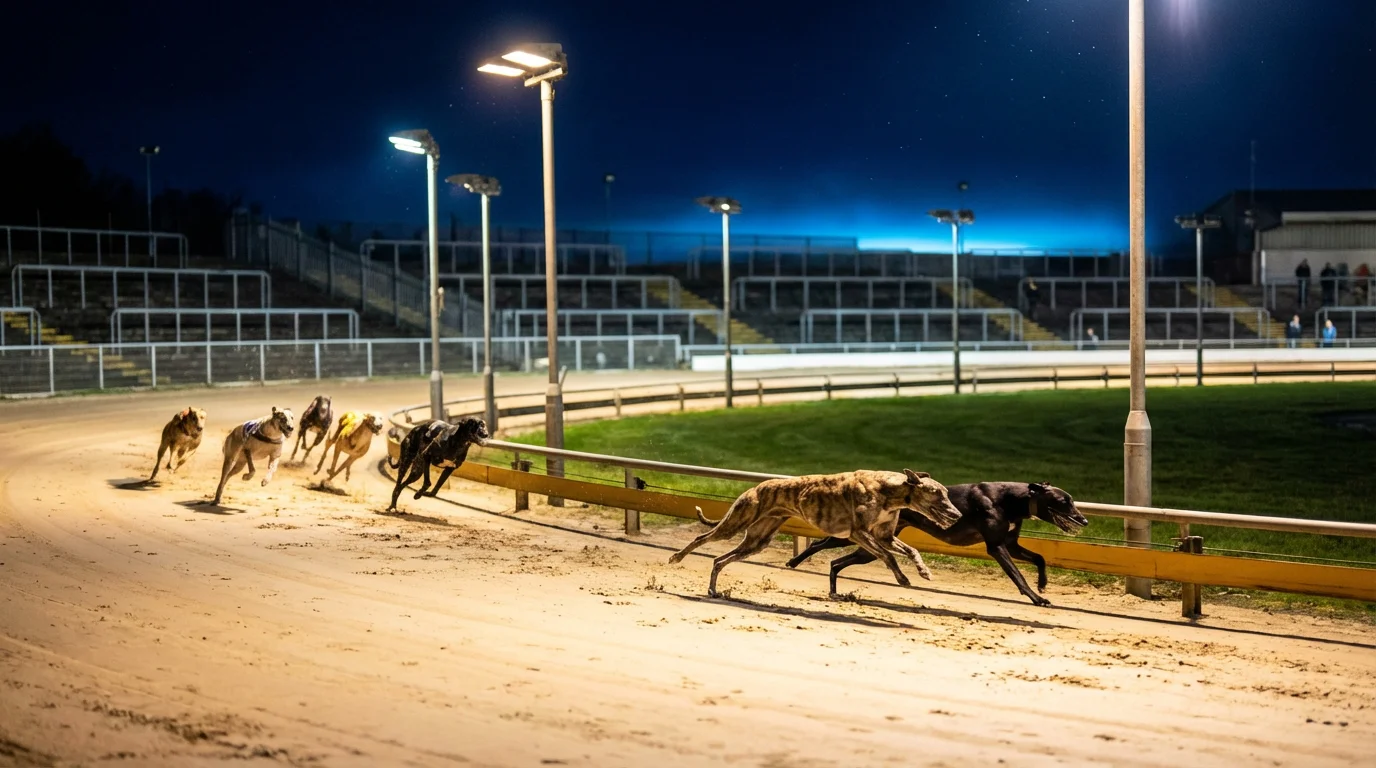
Six dogs, 30 seconds, one result — greyhound betting strips racing down to its fastest, most readable form. While horse racing commands the prestige and the primetime television slots, greyhound racing in the UK quietly sustains a betting market that rewards a different kind of punter: one who values frequency, data density and the structural simplicity of a six-runner field.
The distinction matters more than most casual bettors realise. A standard horse race features fields of eight to twenty runners across distances that can stretch beyond four minutes. A greyhound race packs its entire narrative — trapping, the first bend, the run to the line — into roughly half a minute. That compression changes the analytical equation. There are fewer variables, fewer unknowns, and the data that does exist (form figures, sectional times, trap records) is concentrated enough to be genuinely useful to anyone willing to read it properly.
Greyhound betting in the UK also benefits from sheer volume. On any given day, BAGS and BEGS meetings across the country's licensed tracks produce upward of 80 races, each available for betting through high-street bookmakers and online platforms. That daily throughput creates a rhythm horse racing cannot match outside of major festivals. For the systematic bettor — the one who tracks trainers, specialises in two or three tracks — greyhound racing offers the repetition needed to test ideas against reality.
There is no pretence here that greyhound betting is glamorous. It lacks the hats and the hospitality tents. What it offers instead is a sport whose mechanical simplicity makes it uncommonly transparent for anyone prepared to do the work before the traps open.
UK greyhound racing at a glance: 18 GBGB-licensed stadiums host racing across England and Wales, running six dogs per race over distances from 238 to 1,000 metres. BAGS meetings provide daily afternoon coverage for betting shops, while evening and weekend cards draw trackside crowds. With approximately 6,000 greyhounds registered annually and over 80 races on a typical weekday, the sport sustains one of the most data-rich betting environments in British racing.
How a UK Greyhound Race Works — From Traps to Finish
Before money enters the picture, you need to see what actually happens between the boxes and the line. A UK greyhound race is a controlled sprint: six dogs released simultaneously from numbered traps, chasing a mechanical lure around an oval sand track. The entire contest — from the moment the traps fly open to the moment the first dog crosses the finish — is typically over in less than 30 seconds for a standard 480-metre race.
🐕 Pace & Sectional Analyzer
Form · Tempo · Fair Odds
Ein Greyhound-Rennen liefert konzentrierte Daten – Trap, Sectional Time, Finishing Time, Grade und Running Comment. Gib die wichtigsten Zahlen ein – der Rechner zeigt, ob der Hund echtes Tempo hat oder ob das Ergebnis ein Zufall war.
Each dog wears a coloured blanket corresponding to its trap number: red for trap 1, blue for 2, white for 3, black for 4, orange for 5, and black and white stripes for 6. These colours are standardised across all GBGB-licensed tracks in the UK, so a punter watching at Romford on Monday and Nottingham on Thursday sees the same system. The blanket colours are not merely cosmetic. They tell you immediately which dog is on the rail, which is drawn wide, and — once you understand trap biases at individual tracks — which positions carry a statistical advantage.
GBGB — the Greyhound Board of Great Britain, the regulatory body overseeing all licensed greyhound racing in England and Wales. The GBGB sets the Rules of Racing, licenses trainers and tracks, enforces anti-doping protocols, and publishes welfare and retirement data. As of 2026, it governs 18 registered stadiums.
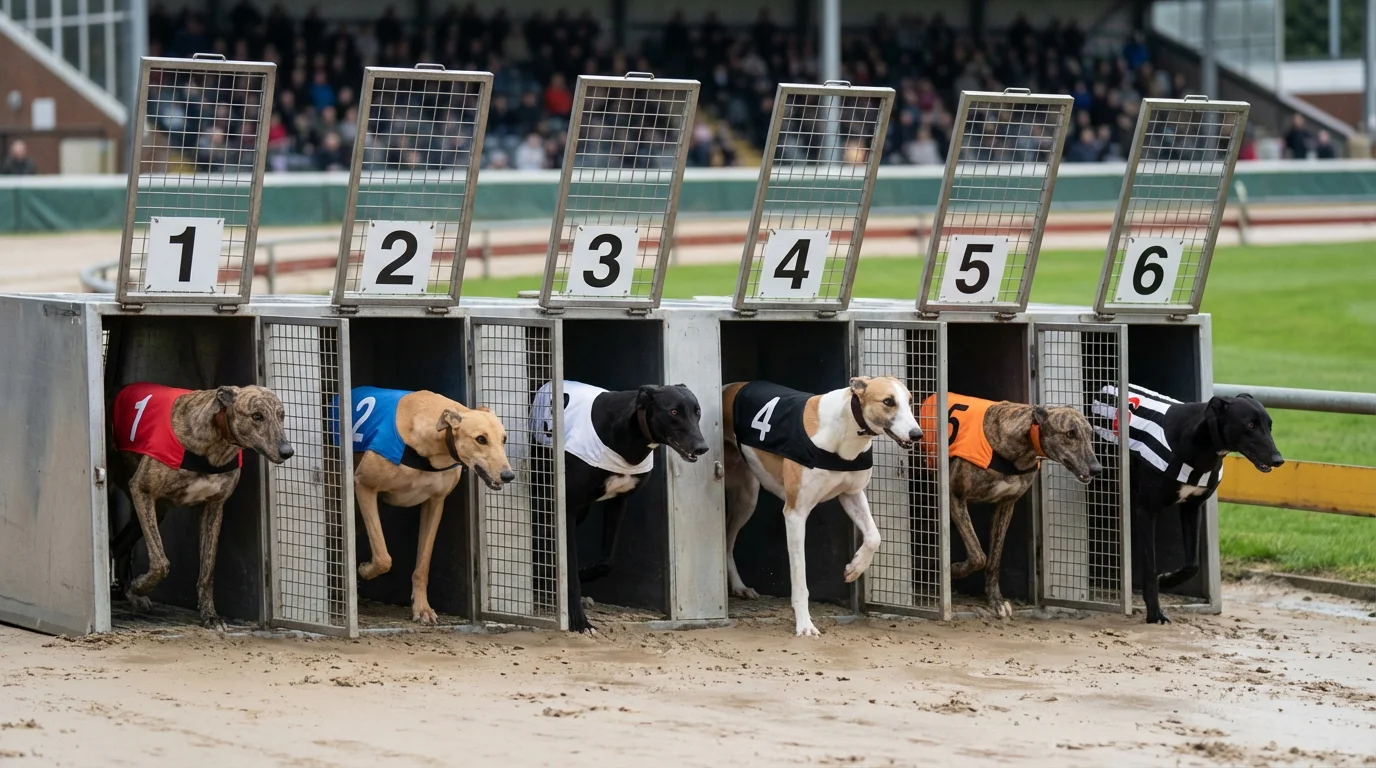
The lure — an artificial hare mounted on an outside rail — sets the pace, maintaining a fixed distance ahead of the leading dog. Dogs are seeded into traps based on their running style: railers (dogs that prefer the inside line) tend to be drawn in traps 1 and 2, middle runners in traps 3 and 4, and wide runners in traps 5 and 6. This seeding is not random; it is determined by the racing manager at each track, using form data and running-style assessments to produce competitive, fair races.
Race distances vary. Sprint races run between 238 and 300 metres, depending on the track configuration. Standard races cover 460 to 500 metres — this is the bread-and-butter distance for most graded racing. Middle-distance events stretch to 550-660 metres, and staying races can reach 840 metres or beyond. Some tracks also stage hurdle races, where dogs clear low obstacles over standard distances. Each distance type demands different physical attributes, which is why a dog that dominates Romford's 400-metre sprints may be outpaced over Nottingham's 500-metre standard trip.
Grading is the engine that keeps races competitive. UK greyhound racing uses a hierarchical grading system, with A1 representing the top tier at a given track and lower grades (A2, A3, down to A9 or beyond) reflecting progressively slower dogs. A greyhound that wins a race is typically promoted one grade; a dog that finishes outside the top three over consecutive runs may be dropped. Open races sit above the graded system, drawing the best dogs from across the country and carrying the largest prize pools. Understanding where a dog sits in this hierarchy — and whether it is rising or falling through the grades — is fundamental to assessing its chances in any given race.
Two scheduling frameworks underpin the daily calendar. BAGS — the Bookmakers' Afternoon Greyhound Service — provides daytime racing for off-course betting markets, feeding live coverage to betting shops and online platforms. BEGS — the Bookmakers' Evening Greyhound Service — does the same for evening fixtures. Independent evening meetings also feature prominently and often attract stronger fields. The distinction matters because BAGS races have the widest odds availability and most consistent streaming coverage, while premium open races at standalone meetings may require more effort to find.
Greyhound Bet Types: Every Wager Available in the UK
Win bets are where everyone starts, but the real texture of greyhound betting lives in forecasts and beyond. The six-runner field that defines UK greyhound racing creates a different betting landscape from horse racing — fewer runners mean shorter-priced favourites, tighter markets, and a wagering menu that shifts in value depending on which type of bet you choose and when you choose it.
What follows is a breakdown of every major bet type available on UK greyhound racing. Some are staples you will use on every card. Others are niche instruments best deployed in specific situations. Knowing which is which separates the punter who bets with intent from the one who ticks boxes at random.
Win, Place and Each Way
A win bet is the simplest wager in greyhound racing: you pick a dog, and if it finishes first, you collect. The payout reflects the odds at the time of bet placement (or the starting price, if you take SP). In a six-runner field, the market favourite typically sits between 2/1 and 5/2, meaning the implied probability the market assigns to the top dog is somewhere around 28-33%. That leaves a lot of room for other runners, and a lot of value for punters who can identify when the market has mispriced a contender.
Place betting pays if your selection finishes in the top two (in standard six-runner races). The odds are reduced — typically to one quarter of the win price — but the cushion of an extra finishing position transforms a marginal selection into a viable one. Each way betting combines both: half your stake goes on the win, half on the place. If the dog wins, both parts pay out; if it finishes second, only the place portion returns. Each way makes most sense when you fancy a dog at longer odds — say 6/1 or above — where the place component offers meaningful returns even without a win.
Forecasts and Tricasts
Forecasts ask you to predict the first two dogs home, and they come in three flavours. A straight forecast (SFC) requires you to name the first and second in the correct order. A reverse forecast (RFC) covers both permutations — your two selections finishing 1st-2nd or 2nd-1st — at the cost of two unit stakes. A combination forecast (CFC) extends this to three or more selections, covering every possible first-and-second pairing among your chosen dogs. The cost scales quickly: three selections produce six combinations, four selections produce twelve.
Straight Forecast Example
Selection: Trap 1 to finish 1st, Trap 4 to finish 2nd
Stake: £5
Forecast dividend declared: £47.20
Return: £236.00
Forecast dividends are calculated by the Computer Straight Forecast (CSF) formula based on starting prices. They are not fixed at the time of bet placement — the payout is determined after the race.
Tricast bets extend the logic to the first three finishers. A straight tricast (STC) requires the correct order of 1st, 2nd and 3rd. A combination tricast (CTC) covers all permutations among your selections: three dogs produce six combinations, four dogs produce twenty-four. The payouts can be substantial — triple-figure returns from modest stakes are common — but the hit rate is correspondingly low. Tricasts reward the punter who has a strong view on a race with a clear form picture, not the one who sprays selections hoping for a windfall.
Accumulators, Trap Challenges and Specials
Accumulators chain win bets across multiple races: each winning selection rolls into the next, compounding the odds. A four-fold accumulator at average odds of 3/1 per leg returns £320 from a £5 stake if all four win — an attractive headline that obscures the mathematical reality that the probability of four independent 25% shots all landing is barely 0.4%. Accumulators are entertainment bets, not strategic instruments, though acca insurance promotions (which refund stakes if one leg fails) shift the value calculation slightly in the punter's favour.
Beyond accumulators, bookmakers offer a range of specialist greyhound markets. Trap challenges let you back a single trap number across an entire meeting — typically six or more races — with the bet paying on cumulative wins. The favourites index works similarly, aggregating the performance of each race's favourite. Tote pools operate on a parimutuel basis: all stakes go into a pool, the house takes its percentage, and the remainder is divided among winning ticket holders. Pool bets include the tote win, tote place, exacta (forecast equivalent) and jackpot pools that carry over across meetings. For the punter who finds fixed-odds markets too tight, tote betting can occasionally throw up outsize returns — particularly when a fancied runner underperforms and the pool is shared among fewer winning tickets.
How Greyhound Odds Work: SP, Early Price and BOG
Starting price is not just a number — it is the market's final word, and sometimes the bookmaker's edge. Understanding how greyhound odds are formed, what they represent, and where the bookmaker's margin hides is not an academic exercise. It is the difference between betting informed and betting blind.
UK greyhound odds are quoted in two formats. Fractional odds — the traditional British notation — express profit relative to stake: 5/1 means £5 profit for every £1 wagered, plus your stake back. Decimal odds, more common on European platforms and betting exchanges, include the stake in the number: 5/1 fractional equals 6.00 decimal. The conversion is straightforward, but the underlying concept is the same. Odds represent the market's assessment of probability, expressed as a price. A dog quoted at 3/1 is being priced at an implied probability of 25% — the market considers it to have roughly a one-in-four chance of winning.
The starting price (SP) is determined at the moment the traps open, compiled by an independent reporter from on-course bookmaker prices. For off-course bettors who do not take an early price, the SP is the default settlement price. The mechanism is shaped by money flow at the track, which can shift in the final minutes. For this reason, many experienced greyhound bettors prefer to take an early price when they have a strong opinion, locking in odds before the market moves.
Early prices are offered by online bookmakers from the morning of a meeting, sometimes earlier. They give the punter a fixed odds contract: whatever happens to the SP, your bet is settled at the price you took. The trade-off is information — by taking an early price, you are committing before the latest intelligence (paddock reports, late market moves, kennel whispers) has been factored in. Whether early price or SP delivers better value depends entirely on the race. In tightly-graded BAGS races, SPs tend to be stable and early prices offer marginal gains. In open races with bigger fields of interest, early prices can move sharply, and getting on at the right moment matters.
Always check whether Best Odds Guaranteed applies to your track and race type. Most major bookmakers offer BOG on BAGS races, but independent evening meetings and premium open events may be excluded. The terms vary between operators and can change during promotional periods — reading the small print once saves money repeatedly.
Best Odds Guaranteed (BOG) is the closest thing to a free upgrade in greyhound betting. When a bookmaker offers BOG, they guarantee that if the SP is higher than the price you took, your bet is settled at the SP instead. If the SP is lower, you keep your original price. It eliminates the downside of taking an early price — you can never be worse off than SP. Not all bookmakers offer BOG on greyhounds, and those that do may restrict it to certain race types or impose maximum payout caps. Nonetheless, for the bettor who routinely takes early prices, a BOG guarantee is a significant structural advantage and should be a baseline criterion when choosing a platform.
Behind every set of odds sits the bookmaker's overround — the built-in margin that ensures the operator profits regardless of the result. In a perfectly fair market, the implied probabilities of all runners would sum to 100%. In practice, a typical greyhound market sums to 115-125%, meaning the bookmaker holds a theoretical edge of 15-25% across the field. This margin is notably wider than in horse racing, where competitive markets often compress the overround to 110% or less. The implication is clear: greyhound bettors need to be more selective, because the house starts with a bigger slice of every market.
Reading a Greyhound Racecard: What the Numbers Tell You
A racecard is a compressed biography of six dogs — every digit carries weight if you know where to look. Six entries, each accompanied by a column of numbers and abbreviations that encode recent form, physical condition, running style and track history. The standard racecard presents: trap number and blanket colour, name and breeding, trainer, racing weight, recent form figures (last six runs), run times and sectional times, finishing positions, grade, distance, and a comment line describing how the dog ran. Some providers add calculated times and career track statistics.
Form Figures
A sequence of digits showing finishing positions in the dog's most recent races, read left to right from oldest to newest. A "1" means a win; "6" means last. Letters indicate non-completions: "F" for fell, "W" for wide running, "M" for middle running complications.
Sectional Time
The time in seconds to reach the first bend — a critical metric that reveals early pace. A dog with consistently fast sectionals is likely to lead into the first turn, a decisive advantage on tight tracks where the first bend determines the race.
Run Time
The total time from traps to finish, measured to hundredths of a second. Comparing run times across races requires adjusting for distance, track, and going conditions — raw times alone are misleading without context.
Weight
The dog's racing weight in kilograms, recorded at kennelling. Significant weight fluctuations between races can signal fitness issues, illness recovery, or changes in training regime. A drop of more than 0.5kg warrants attention.
Trainer
The licensed kennel responsible for the dog's preparation. Trainer form — the recent win rate of all dogs from a kennel — is an underused metric that can flag kennels in hot streaks or fallow patches across an entire card.
Comment Line
A short race description from the racing manager: "led first bend, stayed on" or "crowded second bend, ran on late." These phrases reveal running style and trouble in previous outings — a dog that was "baulked at the first bend" may have run better than its finishing position suggests.

Decoding Form Figures and Sectional Times
Form figures are the first thing most punters scan, and the most commonly misread. A sequence like "321146" tells you a dog has been competitive (3rd, 2nd, 1st, 1st) before dropping off (4th, 6th). The instinct is to focus on the recent decline, but the sharper question is why. Was the dog stepping up in grade? Running at an unfamiliar track? The numbers are a starting point, not a conclusion.
Sectional times add a critical layer. The time from traps to the first bend tells you how quickly a dog breaks and establishes position. On a tight track like Romford, where the bend comes quickly, a fast sectional is almost synonymous with winning. On a galloping track like Towcester, early pace matters less and finishing speed carries more weight. Reading sectionals without reference to specific track geometry is a common error.
Calculated times extend this analysis. Some racecard services publish adjusted times accounting for going, grade of opposition, and interference. These allow direct comparison between runs at different tracks and distances — a level of normalisation that raw times cannot provide. Where available, calculated figures are among the most reliable predictors of future performance.
Weight, Trainer and Track History
Weight changes between races are subtle signals that many punters overlook. A stable weight suggests consistent condition. A gradual increase might indicate a dog growing into peak fitness — or putting on weight due to reduced training intensity. A sharp drop can signal illness or recovery from injury. Tracking weight trends across a dog's last five or six runs adds a dimension that pure form analysis misses.
Trainer statistics deserve more attention than they typically receive. Certain kennels go through sustained hot streaks where runners outperform market expectations across the board. Tracking trainer strike rates — particularly at individual tracks — provides a form shortcut that complements dog-level analysis.
Track history closes the loop. Some dogs thrive at particular tracks and struggle at others. A greyhound that has won three of its last five at Monmore but finished midfield at Crayford is not a dog in poor form; it is a dog that suits one track's geometry and not another's. The racecard makes this information available. Using it is the punter's job.
You can read a racecard in sixty seconds. Building a strategy from what it tells you takes longer — but everything that follows starts with the data you have just learned to decode.
Building a Greyhound Betting Strategy That Works
There is no magic system — but there is a method, and it starts with data you can actually verify. In greyhound betting, a strategy is a repeatable framework for deciding which races to bet on, which to skip, and how to assess value within the races you engage with.
The foundation involves layering multiple data points: recent form, sectional times, running style, trap draw, track geometry, weather conditions, and grade context. No single factor is sufficient. A dog with outstanding form running from a historically weak trap on a wet night at an unfamiliar track is not the same proposition as the same dog at its home venue in dry conditions from a favourable draw. Strategy is the discipline of weighing these factors against each other and against the odds the market offers.
Form-First Approach
- Prioritises recent race results, sectional times and calculated times
- Weights individual dog performance above statistical averages
- Strongest when applied to dogs with extensive race histories at a single track
- Requires consistent racecard data access and the ability to interpret comment lines
- Best suited to punters who follow specific tracks closely and know individual dogs
Trap-Statistical Approach
- Prioritises historical trap win rates, track bias data and aggregate performance metrics
- Weights structural advantages (trap position, track geometry) above individual form
- Strongest when applied across large sample sizes at tracks with pronounced biases
- Requires access to statistical databases and willingness to trust numbers over narratives
- Best suited to punters who spread bets across multiple tracks and seek volume-based edges
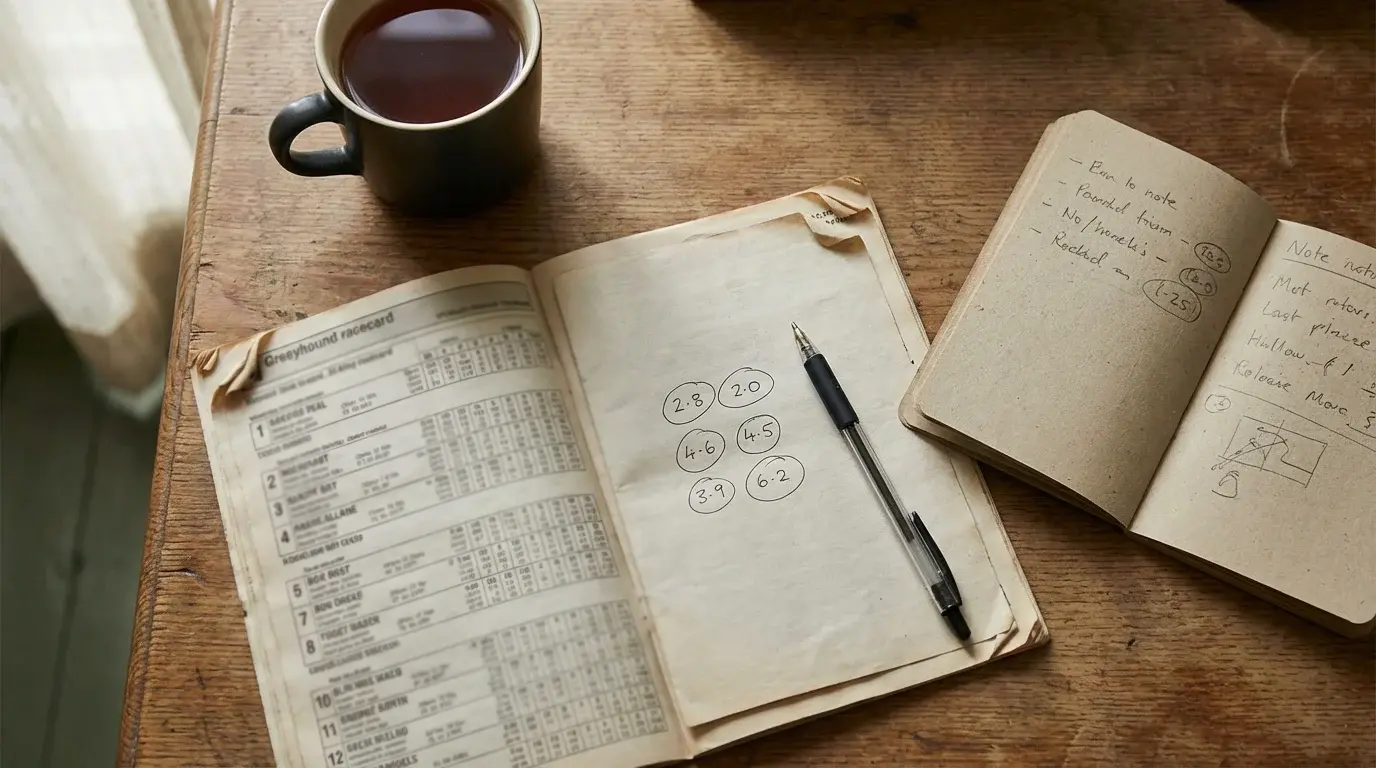
In practice, the most effective greyhound bettors blend both approaches. They use trap statistics as a filter — flagging runners with a structural advantage — and then drill into form data to confirm or reject the statistical signal. Neither approach works in isolation over the long term. Pure form analysis ignores the physical reality of the track. Pure statistical modelling ignores the dog in front of you.
Using Form and Sectional Times to Find Value
Value is the gap between the price the market offers and the probability you assign. A dog that has finished 3-2-1 across its last three races at the same track and distance is improving. If that improvement shows in faster sectional times and the dog is stepping up only one grade, the market may be underpricing its chances because the racecard still shows a "3" from two runs ago.
Sectional times are the sharpest tool here. A dog posting a 3.82-second sectional to the first bend is an early-pace merchant. Draw trap 1 at a tight track, and its chances of leading through the first turn increase markedly. A dog with slower sectionals but a strong finish needs a clear run, making it higher-risk from a wide draw but potentially underpriced because the market overweights early pace.
The discipline is in acting only when the data supports a price discrepancy. A dog might be improving, drawn well, and running at its best distance — but if the market has priced all of this in at 6/4, there is no value. Betting without a meaningful gap between the market's implied probability and your assessed probability is just action for its own sake.
Trap Statistics and Track Bias
Trap statistics quantify a structural feature of greyhound racing that most punters sense but few measure. At every track, certain trap positions win more often than the average 16.7% you would expect in a perfectly level six-runner race. These biases are determined by track geometry: the run to the first bend, the width of the bends, the position of the lure rail. At tracks with a short run to the first bend, inside traps (1 and 2) tend to dominate because the railer reaches the bend first. At wider, galloping tracks, outside traps may benefit from a cleaner run.
Using trap data effectively means working at the track level, not the national level. A 19% win rate for trap 1 across all UK tracks is a statistical average that conceals as much as it reveals. At some venues, trap 1 wins 22% of races; at others, barely 14%. The actionable insight is in the track-specific deviation from the mean — the bias, not the baseline. Databases that break down trap performance by track and distance provide the raw material; the punter's task is to integrate this data with the form picture of the dogs actually drawn in those traps on race day.
Weather, Distance and Grade Adjustments
Sand tracks drain differently depending on rainfall and temperature. A wet track slows times across the board, but it penalises lighter dogs disproportionately. Heavier greyhounds — typically those over 32kg — handle soft going better, maintaining stride length where smaller dogs shorten up. If rain has been falling at a venue all afternoon, adjust your assessment based on weight as much as form.
Distance is another lens. A dog switching from sprints to a standard 480-metre race is being asked to sustain speed for twice as long — some make this transition comfortably, others fall away in the final hundred metres. Grade context complicates the picture further. A dog dropping from A2 to A4 meets weaker opposition, but the reason for the drop matters: was it injury, a poor draw, or genuine decline? The racecard gives you the trajectory. The interpretation is yours.
UK Greyhound Tracks: Where the Dogs Run
Eighteen licensed stadiums, each with its own geometry, its own biases, its own regulars. That number has contracted in recent years — the last independent (flapper) track in Britain closed in March 2025, and the GBGB now oversees all registered racing across England and Wales. Knowing which tracks host which types of racing, and how their physical characteristics affect outcomes, is a genuine competitive advantage.
Romford is the sharpest track on the circuit for betting purposes. Tight bends, a short run to the first turn, and heavy BAGS scheduling make it a volume venue where trap 1 and trap 2 carry a measurable edge. It is a railer's track — dogs that hug the inside rail dominate, and wide runners consistently underperform relative to their form at other venues. Crayford, also in south-east London, is flatter and more neutral in its trap bias, running standard distances with a relatively long straight that gives closers a chance. Hove (Brighton and Hove) sits further south, offering a wider track that accommodates bigger-striding dogs and produces more competitive races from outside traps.
The Midlands and North house several of the busiest tracks in the country. Monmore Green in Wolverhampton is a workhorse venue: tight, fast, and relentless in its BAGS scheduling. Perry Barr in Birmingham operates similarly, with a track shape that rewards early pace. Sheffield (Owlerton) adds a galloping dimension — its larger circumference suits stayers and dogs with a strong finish. Nottingham is the venue most associated with prestige in the northern half of the country, hosting open races and major events alongside its regular graded card.
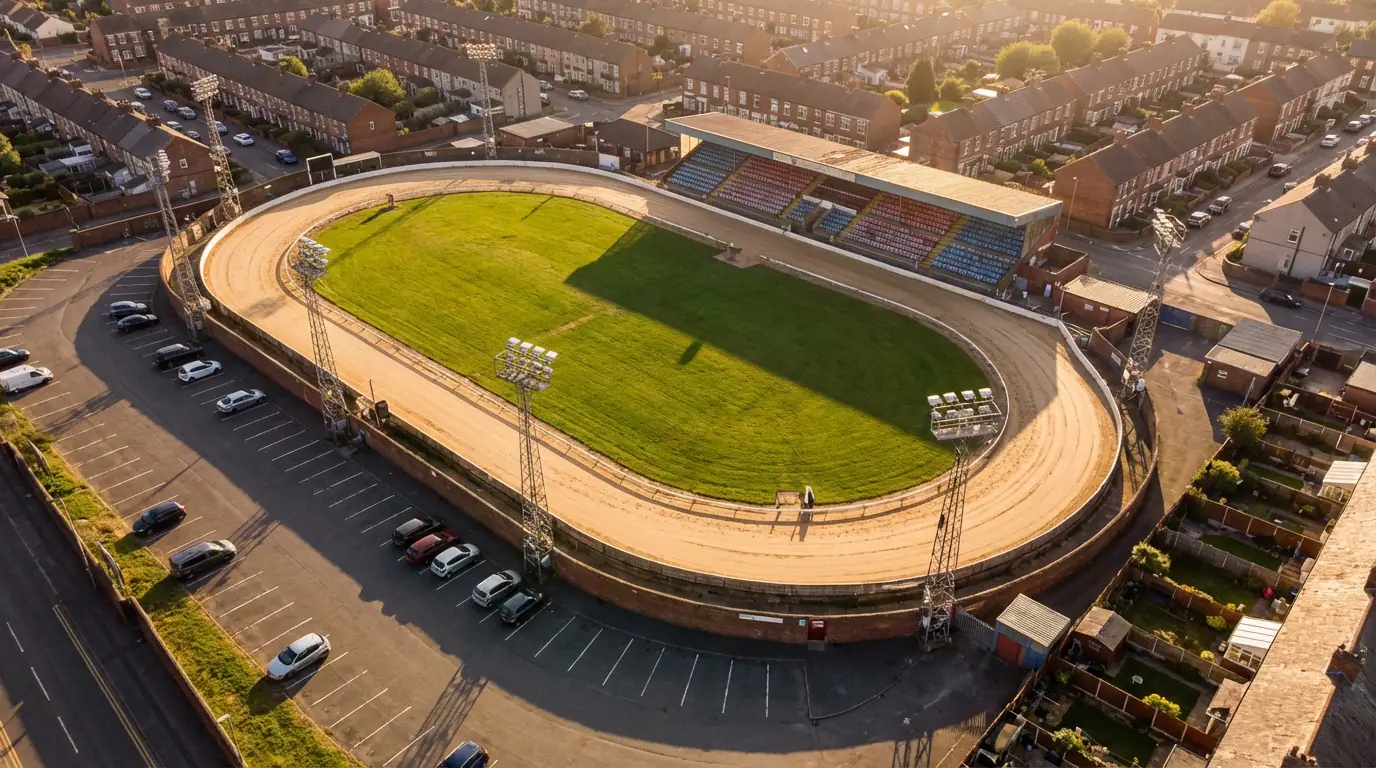
Beyond the established circuits, Towcester in Northamptonshire occupies a unique position. Built on the site of a former National Hunt horse racing venue, its 420-metre circumference and long home straight make it one of the fairest tracks in the UK for outside draws. It is also the current home of the English Greyhound Derby, the sport's most prestigious event. Other tracks — Sunderland, Kinsley, Henlow, Harlow, Newcastle, Doncaster, Oxford, Swindon, Central Park (Sittingbourne), Yarmouth and Pelaw Grange — each have their own characteristics worth learning if you intend to bet on them regularly.
The common thread across all venues is that track knowledge converts to betting edge. A punter who has watched fifty races at Monmore understands its biases in a way that no statistical summary can fully capture. They know how the sand drags after heavy rain. They know which trainer's dogs handle the tight first bend. They know when the lure is set faster than usual. This accumulated, venue-specific knowledge is the most undervalued asset in greyhound betting.
Track knowledge is the single most underrated edge in greyhound betting — specialise in two or three venues before spreading wider.
Major UK Greyhound Events Worth Betting On
The Derby, the St Leger, the Oaks — greyhound racing borrowed the names and built its own prestige. The major events on the UK greyhound calendar represent the sport at its highest standard, drawing the best dogs from across Britain and Ireland into multi-round competitions that unfold over weeks. For bettors, these events offer a different proposition from daily graded racing: bigger fields of contention, ante-post markets with meaningful price movement, and a level of public interest that widens the pools and, occasionally, distorts the odds.
The English Greyhound Derby is the sport's flagship. The 2026 edition runs at Towcester from 30 April through to the final on 6 June, marking the centenary year of greyhound racing in Britain — the sport traces its origins to the first modern race at Belle Vue, Manchester, in July 1926. The Derby format is a multi-round knockout over 500 metres: first-round heats, second-round heats, quarter-finals, semi-finals and a six-dog final. The winner's purse is £175,000. Dogs are seeded by running style, and the quality of opposition intensifies with each round, meaning the Derby is as much a test of consistency and soundness over six weeks as it is of outright speed. Ante-post markets open well before the first round, and prices shift sharply after each heat result — early information from first-round performances is among the most valuable data points in greyhound betting.
The Greyhound St Leger, a staying championship most recently held at Nottingham's Colwick Park after moving from Perry Barr in 2025, is run over 730 metres. It tests stamina in a way the Derby does not, and its relatively niche distance means the field is drawn from a smaller pool of specialists. The Oaks, for bitches only, mirrors the Derby in format and prestige. The TV Trophy, Essex Vase, Cesarewitch and various puppy derbies round out a calendar that, in its 2026 iteration, features 50 Category One competitions and 27 Category Two events — the GBGB's richest open-race schedule in years, reflecting the centenary celebrations.
For bettors, the calendar is not just a list of dates. It is a planning tool. Ante-post markets on the Derby and St Leger open months in advance, and the shrewd punter uses the gap between early prices and the eventual SP to capture value. The risk is non-runners — ante-post bets on greyhounds are typically "all in, run or not," meaning your stake is lost if the dog is withdrawn due to injury or poor heat performance. Managing this risk, either by limiting ante-post exposure to affordable stakes or by hedging in later rounds, is a discipline that separates the speculator from the strategist.
Betting on Greyhounds Online: What to Look For
Not every bookmaker treats greyhound racing as more than an afterthought — the ones that do stand out fast. The migration from high-street betting shops to online platforms has been thorough for horse racing, football and most mainstream sports, but greyhound racing's online experience varies wildly between operators. Some platforms bury greyhound markets behind three navigational layers, offer limited race coverage, and strip out the data tools that make informed betting possible. Others treat the sport as a first-class product, with full BAGS and BEGS scheduling, integrated racecard data, live streaming and competitive odds.
The first criterion is coverage. Does the platform list every BAGS and BEGS meeting, or only selected cards? Are odds available from the morning, or do markets open close to race time? Coverage gaps are not merely inconvenient — they represent missed opportunities. A bookmaker that posts early prices by 10am on a full afternoon BAGS card gives the punter a window to identify value before the market moves. One that opens markets thirty minutes before the first race does not.
Live streaming is the second non-negotiable. Most major UK bookmakers stream live greyhound racing to customers who have either a funded account or a small qualifying bet on the race. Streaming quality varies, but the functional question is whether you can watch every race you bet on. Monitoring live races is not just entertainment. It is research: observing how a dog traps, how it handles the first bend, whether it shows early pace or finishes strongly. Over time, this visual data supplements the racecard numbers and sharpens your assessments in ways that static form figures cannot.
Best Odds Guaranteed, discussed earlier, should be a baseline feature. Beyond BOG, look for racecard integration — the ability to view form, sectional times and trainer data directly within the betting interface, without switching to a third-party site. Some platforms embed Racing Post or Timeform data into their greyhound pages, giving the punter a one-screen workflow. This matters in a sport where BAGS meetings can run twelve races in ninety minutes.
Promotions specific to greyhound racing are worth evaluating, though not overweighting. Free bet clubs, acca insurance, forecast bonuses and tricast payouts all shift the value equation marginally. The danger is letting promotions dictate your betting behaviour — placing a forecast because the platform offers a 10% bonus rather than because the race merits one. The best approach is to identify two or three platforms whose core offering (coverage, streaming, BOG, racecards) meets your requirements, and then treat promotions as a secondary benefit that may tilt a marginal decision.

Do
- Check if BOG covers all UK tracks, including independent meetings
- Test the live streaming on mobile before committing — buffering on BAGS races is a dealbreaker
- Compare early prices across two or three platforms before settling on a selection
- Use platforms that integrate racecard data directly into the betting slip
Don't
- Assume all sites stream every BAGS and BEGS meeting — coverage gaps are common
- Let sign-up bonuses drive your choice of primary bookmaker for greyhound betting
- Overlook cash-out terms, which can differ substantially between operators on greyhound markets
- Ignore responsible gambling tools — deposit limits and session timers are especially important given the frequency of greyhound racing
Greyhound Betting: Common Questions Answered
How do greyhound betting odds work?
Greyhound odds represent the bookmaker's assessment of each dog's chance of winning, expressed as a price. In fractional odds (the UK standard), 4/1 means you receive £4 profit for every £1 staked if the dog wins, plus your stake back. Decimal odds include the stake: 4/1 fractional equals 5.00 decimal. The starting price (SP) is the final market price at the moment the traps open, determined by on-course bookmakers and compiled by an independent reporter. Many online platforms offer early prices from the morning, which you can lock in before the market moves. Best Odds Guaranteed (BOG) promotions ensure you receive whichever is higher — your early price or the SP — removing the risk of taking a price that later drifts in your favour. The sum of implied probabilities across all six dogs in a race typically exceeds 100%, with the surplus representing the bookmaker's margin (overround), which in greyhound markets usually ranges from 115% to 125%.
What is a forecast bet in greyhound racing?
A forecast bet requires you to predict the first two dogs to finish a race. In a straight forecast (SFC), you must name them in the exact order — first and second. A reverse forecast (RFC) covers both orders, costing two unit stakes. A combination forecast (CFC) lets you select three or more dogs and covers every possible first-and-second pairing among them. Three selections produce six combinations (six times your unit stake); four selections produce twelve. Forecast payouts are not based on the odds displayed before the race. Instead, they are calculated after the race using the Computer Straight Forecast (CSF) formula, which derives dividends from the starting prices of the first two finishers. This means returns can vary significantly — a forecast involving two outsiders may pay substantially more than one involving the favourite and second favourite.
How many dogs run in a UK greyhound race and does trap position matter?
Standard UK greyhound races feature six dogs, each running from a numbered trap (1 through 6) wearing a colour-coded blanket: red, blue, white, black, orange, and black-and-white stripes respectively. Trap position matters considerably. Dogs are seeded based on running style — railers (inside runners) are typically drawn in traps 1 and 2, middle runners in traps 3 and 4, and wide runners in traps 5 and 6. Beyond this seeding, the physical layout of each track creates measurable biases. At tracks with a short run to the first bend, inside traps statistically outperform because they reach the turn first. At wider, galloping tracks, outside draws can be equally competitive. These biases are track-specific — trap 1 at Romford performs very differently from trap 1 at Towcester — so understanding the venue is essential before weighting trap position in your analysis.
The 30-Second Edge
Greyhound betting rewards the punter who does the work before the traps open, not the one who chases the hare. That sentence could stand as the entire conclusion to this guide, but it is worth unpacking — because the nature of the edge available in greyhound racing is fundamentally different from what most sports bettors are accustomed to.
In football or horse racing, information asymmetry is the traditional source of value: knowing something the market does not, or knowing it sooner. In greyhound racing, the information is largely public. Racecards, form figures, sectional times, trap statistics, trainer records — all of it is available to anyone with an internet connection and the patience to read it. The edge does not come from secret knowledge. It comes from the discipline to use public knowledge more rigorously than the majority of the market, which, in greyhound betting, consists overwhelmingly of recreational punters making decisions in under sixty seconds.
This is what makes the sport so attractive to a certain type of analytical bettor. The data exists. The markets are liquid enough to bet into but inefficient enough to exploit. The frequency of racing — 80-plus races a day across UK tracks — provides the sample size that any systematic approach requires to prove itself over time. And the six-runner field, for all its apparent simplicity, produces enough variability at the first bend to ensure that even well-analysed races involve genuine uncertainty. It is not a solved game. It is a game where preparation is rewarded more consistently than in most alternatives.
The specifics of preparation will vary. Some will build spreadsheets tracking trap performance at two preferred tracks. Others will become students of a single trainer's kennel, learning to recognise when a dog is being aimed at a particular race weeks in advance. Some will specialise in forecasts, pairing dogs the market treats as independent events. What unites every effective approach is a willingness to narrow focus — to bet fewer races with more conviction, rather than spreading thin across every meeting.
Greyhound racing in Britain is entering an interesting phase. The 2026 season marks 100 years since the first modern race at Belle Vue, and the sport has never been more accessible to the data-driven bettor. Streaming coverage reaches every BAGS meeting. Racecard data is richer and more widely available than at any point in the sport's history. The GBGB's expanded open-race calendar for the centenary year — 50 Category One events — means more premium racing to analyse and wager on. For the punter who approaches the sport with discipline, a focused track strategy, and a genuine respect for the numbers, the 30-second race offers more than enough time to find an edge. The work happens before the traps open. The race just confirms what you already knew.
