UK vs Australian Greyhound Racing: Key Differences for Bettors
 Available in US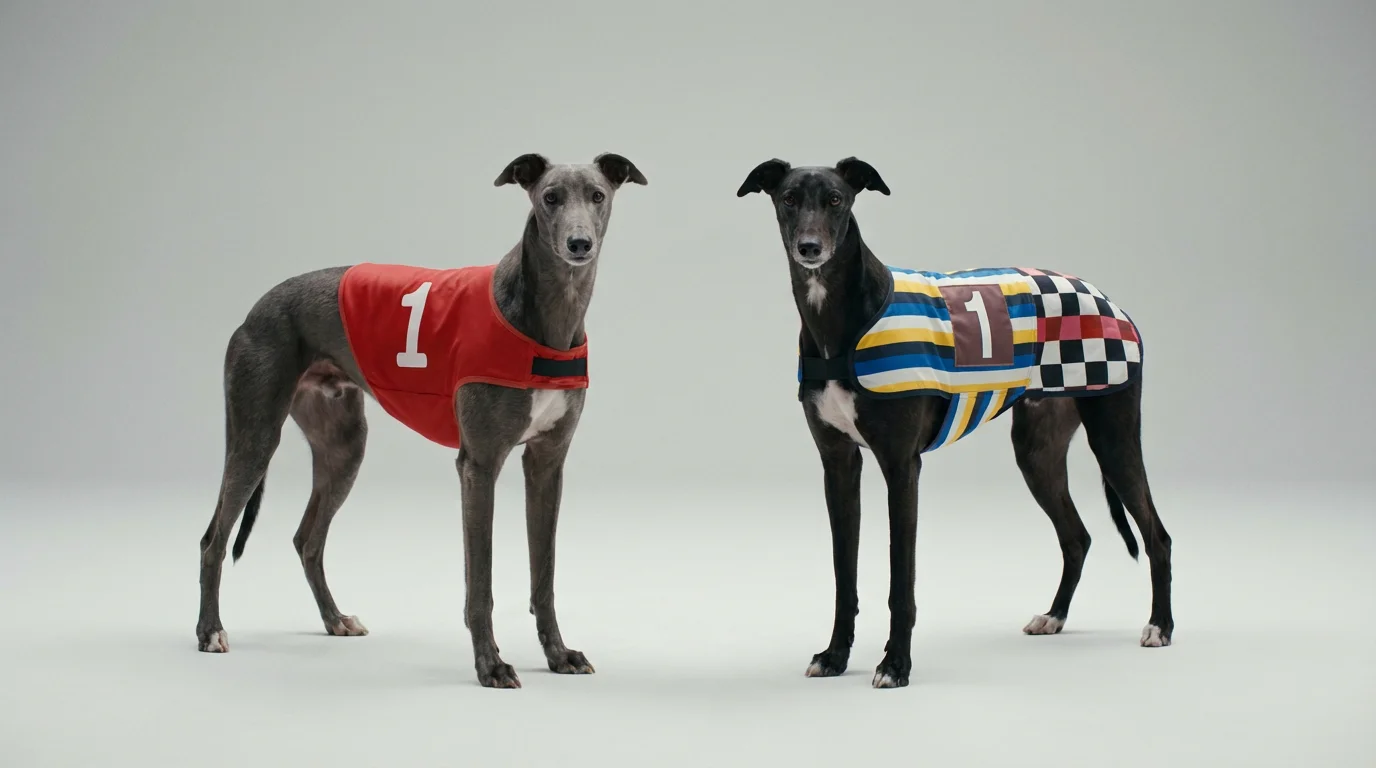
Why the Comparison Matters
Australian greyhound racing is the largest in the world by volume. More races, more tracks, more betting turnover. UK punters encounter Australian greyhound markets through their bookmakers — most major UK operators offer odds on Australian meetings, particularly during the early morning hours when UK tracks are silent. The temptation to apply British greyhound knowledge to Australian races is strong. The danger is assuming the two products are the same. They are not, and the differences affect how you should analyse, select and bet.
The structural differences between UK and Australian greyhound racing are not trivial variations. They change the dynamics of every race: how the field moves, where interference occurs, how trap draw affects outcomes, and how the betting market behaves. A punter who has mastered UK greyhound form analysis and applies it unchanged to Australian racing is bringing assumptions to a context that does not share them. Understanding the differences is a prerequisite for betting on both codes with any kind of informed edge.
Read the history of UK greyhound racing in history greyhound racing.
Structural Differences: Lure, Fields and Track Design
The most fundamental difference between UK and Australian greyhound racing is the position of the mechanical lure. In the UK, the lure runs on the outside of the track, meaning dogs chase it around left-handed bends (anticlockwise). In Australia, the lure runs on the inside of the track at most venues. Both codes race anticlockwise, but the inside lure position changes the geometry — dogs run closer to the inside rail as they chase the lure, and the positional dynamics through bends differ from the UK’s outside-lure setup. This is not an aesthetic detail. It alters the racing line of every runner.
In UK racing, the inside rail is the shortest path and the rail advantage belongs to trap 1. In Australian racing, with the lure on the inside, the rail dynamics can differ depending on the specific track layout. Some Australian tracks produce a strong inside-box advantage similar to the UK. Others, due to their configuration and lure position, create different positional dynamics that do not mirror the British trap 1 edge.
Field sizes represent the second major structural difference. UK greyhound racing uses six-runner fields universally. Australian racing typically runs eight-runner fields, with some tracks occasionally using fields of seven. Two additional runners transform the competitive dynamics. Eight dogs produce more possible finishing combinations — there are 336 possible tricasts with eight runners compared to 120 with six. The first bend in an eight-dog race is more congested, interference is more frequent, and the probability of any single dog winning drops from roughly 16.7 per cent (one in six) to 12.5 per cent (one in eight) at baseline.
Trap colours differ between the two countries. UK greyhounds wear red (trap 1), blue (2), white (3), black (4), orange (5) and black-and-white stripes (6). Australian greyhounds wear a different colour scheme that includes pink, chocolate, and other colours not used in the UK. The practical relevance for bettors is minimal — it is a visual distinction rather than a competitive one — but it can cause confusion when switching between the two codes on a bookmaker platform.
Track design varies more widely in Australia than in the UK. Australian tracks range from very tight circuits (like some New South Wales venues) to large, sweeping ovals (like Sandown in Victoria). The variety in track shapes means that trap-draw data, sectional-time benchmarks and running-style profiles are even more venue-specific in Australia than they are in Britain. A dog that dominates at one Australian track may be poorly suited to another, and the differences can be more extreme than between UK venues.
Racing Style and Grading Differences
The additional two runners in Australian fields produce a different racing style. With eight dogs competing for position at the first bend, the racing is more chaotic. Crowding, checking and interference occur more frequently, and the dog that avoids trouble is rewarded more consistently than in UK racing where six-dog fields produce slightly cleaner races. In Australia, a “trouble-free run” is a more significant competitive advantage because trouble is more likely.
This has implications for running-style analysis. Leaders in Australian racing face more challengers for the front and must navigate a more congested first bend. Closers have more ground to make up against a larger field but also benefit more from the interference that larger fields produce at the front of the pack. The balance between leading and closing is shifted slightly toward closers in eight-runner Australian races compared to six-runner UK contests, though leaders still hold a statistical advantage overall.
Australian grading systems vary by state — each state’s greyhound authority (Greyhound Racing New South Wales, Greyhound Racing Victoria, Racing Queensland, etc.) operates its own grading framework. The principles are similar to the UK: dogs are graded by recent performance and move between grades based on results. But the specific structures, grade names and promotion/relegation triggers differ between states and between individual tracks. A punter accustomed to the UK’s A1-to-A11 system will find the Australian landscape less familiar and more fragmented.
Race distances in Australia tend to centre on different standard trips than the UK. The most common Australian distance is around 515 metres at many tracks, compared to the UK’s standard 480. Sprint races in Australia can be as short as 300 metres or as long as 400, while staying races can extend beyond 700 metres. These distance differences mean that time comparisons between UK and Australian dogs are essentially meaningless — different tracks, different distances, different lure positions.
Betting Differences: Odds, Markets and Time Zones
Australian greyhound betting markets are available at most major UK bookmakers, typically from the early morning hours (UK time) when Australian evening meetings are underway. The time zone difference means that Australian races run between roughly midnight and 10 a.m. GMT, covering the gap in UK racing coverage. For punters who bet on greyhounds outside standard UK racing hours, Australian markets are the primary alternative to virtual racing.
Odds formats in Australia default to decimal, reflecting the country’s standard betting convention. UK bookmakers offering Australian greyhound markets typically display prices in the punter’s preferred format (fractional or decimal), so the format itself is not a barrier. The market structure, however, differs. Australian tote pools are generally larger than UK equivalents, reflecting higher betting volumes. Fixed-odds markets offered by UK bookmakers on Australian races are priced from the Australian market, which means the overround and pricing dynamics reflect Australian, not British, conditions.
Best odds guaranteed is typically not available on Australian greyhound racing through UK bookmakers. BOG is a UK-focused promotion tied to UK racing, and most operators exclude international meetings. This removes one of the most valuable promotional tools available to UK greyhound punters. Without BOG, the early-price versus SP decision carries real cost — you take one or the other, with no safety net.
Live streaming of Australian greyhound racing is available at some UK bookmakers, though coverage is less comprehensive than for UK meetings. Where available, the streams provide the same analytical utility as UK streams — watching trap breaks, bend running and finishing efforts builds knowledge that racecard data alone cannot provide. The video quality and latency vary by operator, and the commentary is Australian, which may require acclimatisation for UK-based viewers unfamiliar with Antipodean racing terminology.
Form data for Australian greyhounds is less readily available on UK bookmaker platforms than UK greyhound data. Some operators display basic form figures, but the depth of racecard information — sectional times, calculated times, trainer data, comment lines — is often thinner than for UK racing. Serious punters betting on Australian greyhounds may need to source data directly from Australian providers such as Greyhound Recorder or the individual state greyhound authority websites.
Same Sport, Different Game
UK and Australian greyhound racing share a foundation: dogs chasing a mechanical lure around a track. Everything built on that foundation differs. The lure position changes the racing geometry. Eight-runner fields change the probability landscape. Different grading systems, distances and track designs mean that UK-specific knowledge does not transfer cleanly. The punter who treats Australian greyhound racing as a direct extension of the British product will make systematic errors that compound over time.
If you choose to bet on Australian greyhound racing — and the early-morning schedule makes it a convenient option for night owls and early risers — invest the time to learn the differences. Study the tracks. Understand the eight-runner dynamics. Source reliable form data. And do not assume that what works at Romford will work at Sandown. They are chasing a different lure on a different line.
Compare UK and Australian greyhound racing on the greyhoundbettinguk homepage.
