Greyhound Trap Statistics: Does Position Matter?
 Available in US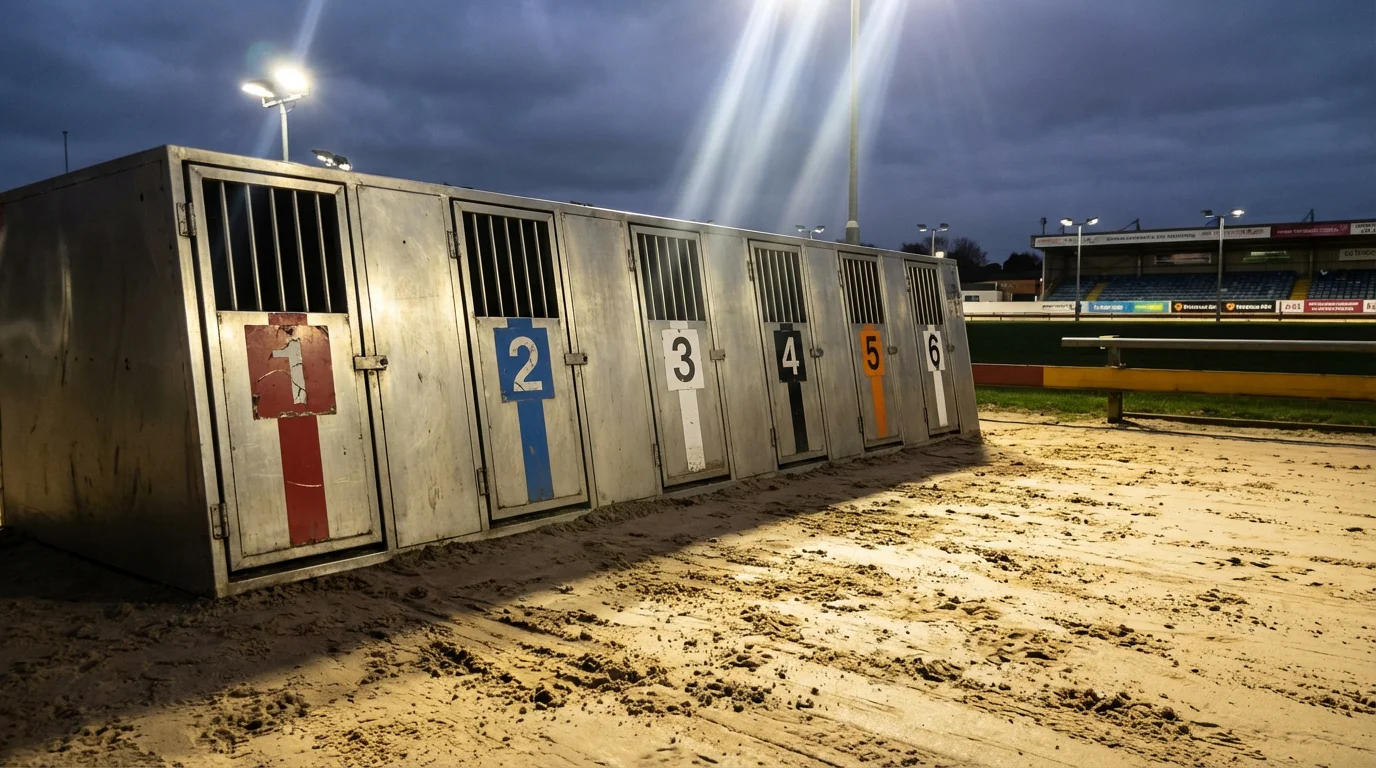
The Trap Debate: Advantage or Myth
Ask any greyhound punter whether trap position matters and you will get a confident answer. The problem is that half of them will say yes and the other half will say it depends. Both are partially right. Trap statistics across UK greyhound racing do show measurable differences in win rates between positions — but the size of those differences, the reasons behind them, and their usefulness as a standalone betting tool are more complicated than the headline numbers suggest.
In a six-trap race, a perfectly even distribution would see each trap winning 16.67 per cent of the time. In practice, national aggregate data shows trap 1 winning slightly more often than that — typically in the range of 18 to 20 per cent — while middle traps sometimes dip below the average. The inside position, closest to the rail, appears to offer a small structural advantage. But averages across all UK tracks mask enormous variation between individual venues, and it is the track-specific data that matters for betting, not the national aggregate.
The trap position question is not whether it matters in absolute terms — it does — but whether the market already accounts for it. If bookmakers and punters both know trap 1 wins slightly more often, the odds on trap 1 runners are adjusted accordingly. The edge, if it exists, lies not in the raw statistic but in the gap between what trap data tells you and what the market prices in.
Apply trap stats when reading the racecard in read racecard like a pro.
National Aggregate Data: What the Numbers Show
Across all registered UK greyhound tracks, long-term data paints a consistent picture. Trap 1 wins more often than any other position, typically recording win rates between 18 and 21 per cent over large sample sizes. This represents a two to four percentage point advantage over a perfectly equal distribution — meaningful in statistical terms, but modest in practical betting terms.
The reason for the trap 1 advantage is geometric. In UK greyhound racing, the lure runs on the outside of the track, and the first bend comes shortly after the traps. The dog in trap 1, on the inside rail, has the shortest distance to travel to the first bend. If it breaks even reasonably well from the traps, it reaches the bend first and claims the rail — the shortest path around the entire circuit. Once on the rail, the dog benefits from every subsequent bend, shaving distance that wider-running dogs must cover.
Trap 6, on the outside, has the longest route to the first bend but the least congestion on its immediate inside. Some data sets show trap 6 outperforming middle traps (3, 4) at certain tracks, because the wide draw allows the dog to run freely without being checked by traffic at the first bend. At venues where the run to the first bend is long, this outside freedom can compensate for the extra distance.
Middle traps — particularly traps 3 and 4 — tend to show the lowest win rates in national data. These positions face the worst of both worlds: they lack the rail advantage of trap 1 and the clear-air advantage of trap 6. Dogs drawn in the middle often find themselves squeezed between rivals at the first bend, forced to check their stride, and emerging from the turn in mid-pack with ground to make up.
However — and this is where the nuance begins — national aggregate data is a blunt instrument. It combines results from twenty-plus tracks with different configurations, different run-up distances to the first bend, different bend radii, and different track surfaces. Averaging across all of them produces a statistical trend that may not apply to any specific venue. Trap 1 wins 21 per cent nationally, but at individual tracks that figure might be 15 per cent or 25 per cent. The track-by-track data is where the real information lives.
Track-by-Track Trap Bias: Where the Real Edge Hides
Every UK greyhound track has its own trap profile, shaped by its unique geometry. The run from traps to first bend, the tightness of the bends, the camber of the track, and even the position of the hare rail all influence which traps produce more winners. Understanding these venue-specific biases is one of the most underused edges in greyhound betting.
Romford, one of the busiest UK tracks, runs a tight circuit with a short run to the first bend. Data historically shows trap 1 performing strongly here because the first bend arrives quickly, favouring the inside runner. A dog with early pace drawn in trap 1 at Romford is in a genuinely advantageous position. Conversely, the same dog drawn in trap 5 at Romford faces a very different race, needing to cross traffic or take the bend wide.
At Towcester, with its larger circuit and longer run to the first bend, the trap 1 advantage diminishes. Dogs from wider draws have more time to establish their running position before the first turn. Trap statistics at Towcester over recent seasons have shown trap 1 winning closer to 17 per cent — still above average but significantly less than at tighter tracks. Some seasons, trap 6 at Towcester has produced win rates matching or exceeding trap 1, reflecting the extra galloping room the wider draw provides.
Harlow presents one of the most notable trap biases in UK greyhound racing. Trap 6 at Harlow has historically recorded win rates above 20 per cent in graded racing — a striking outlier that defies the typical inside-trap advantage. The track’s configuration, with its particular bend geometry and run-up distance, appears to favour wide-running dogs in a way that overrides the standard rail benefit.
Sheffield, Hove, Monmore, Nottingham and Crayford each have their own statistical profiles. At some of these venues, the trap 1 advantage is pronounced. At others, it barely exists. The data changes from year to year as track surfaces are maintained, hare positions are adjusted, and the population of racing dogs shifts. A trap bias that was strong three years ago may have softened or reversed.
The practical lesson is that track-specific trap data must be current. Using figures from five years ago is unreliable. The most useful approach is to review the past twelve to twenty-four months of trap statistics at your chosen track, using data from the Greyhound Board of Great Britain or reputable greyhound data services. Focus on graded racing — open races and feature events attract different dog profiles and can distort the trap statistics.
Incorporating Trap Data Into Your Selection Process
Trap statistics are a filter, not a selection method. The punter who bets trap 1 blindly in every race will win slightly more often than random — but the bookmaker already knows trap 1 wins more often, and the odds are priced accordingly. Blindly backing the inside draw does not produce long-term profit because the market adjusts for the advantage.
Where trap data becomes genuinely useful is as a tiebreaker and as a risk assessor in combination with form analysis. Consider a race where your form analysis identifies two dogs as realistic contenders. One is drawn in trap 1 at a track where trap 1 wins 22 per cent of the time. The other is drawn in trap 4 at the same track, where trap 4 wins 14 per cent. Both dogs have similar recent form. The trap data tips the balance — not as a sole reason to bet, but as a weighting factor that helps you choose between two closely matched selections.
Trap data also flags danger. If you are considering a bet on a dog whose form is strong but whose trap draw is historically weak at the specific venue, the data warns you to discount the form slightly. A fast dog drawn in trap 3 at a track where trap 3 produces the fewest winners faces a structural headwind. That headwind might not stop a sufficiently talented runner, but it reduces the probability enough to affect whether the available price represents value.
For forecast and tricast bets, trap data takes on additional importance. Predicting the exact finishing order is partly about assessing how the race will unfold from the first bend, and trap position is a key input into that assessment. A dog with fast sectional times drawn in trap 1 at a tight track is likely to lead early and hold the rail. A closer drawn in trap 6 is likely to settle wide and make ground late. Those running-line projections — informed by trap stats, running styles and sectional data — are the foundation of forecast analysis.
Why Trap Stats Alone Are Not Enough
The temptation to over-rely on trap statistics is real, precisely because the data is clean and easy to interpret. Trap 1 wins 20 per cent at this track. Trap 4 wins 13 per cent. The numbers are clear. But clarity is not the same as completeness.
Trap statistics tell you what has happened historically at a venue. They do not tell you about the specific dogs in today’s race. A dog with overwhelming form and fast sectional times drawn in trap 4 is still a strong contender, regardless of what trap 4’s aggregate win rate says. The aggregate includes every dog that has ever drawn trap 4 at that track — talented and mediocre alike. Your analysis of the actual runner should carry more weight than the track average.
Weather and going conditions can amplify or neutralise trap advantages. On a wet track, inside traps may suffer if the rail becomes choppy from repeated use, while outside draws benefit from firmer ground. These temporary condition shifts are invisible in historical trap data.
Position Is Context, Not Destiny
Trap position matters in greyhound racing. The data confirms it. But it matters as one variable among many — alongside form, fitness, running style, distance suitability, grade, trainer form and going conditions. The punter who integrates trap statistics into a broader analytical framework gains a genuine edge. The punter who treats trap position as a strategy in itself discovers, over time, that the bookmaker priced that advantage in long before they noticed it.
Analyse trap statistics on the greyhoundbettinguk homepage.
