Greyhound Racing Bet Types: Every Wager Explained
Best Greyhound Betting Sites – Bet on Greyhounds in 2026
Loading...
The Full Menu of Greyhound Bets — and When to Order What
Six dogs in a race, dozens of ways to bet on them — and most punters use three at best.
That is not necessarily a bad thing. Mastering a handful of bet types and knowing when to deploy each one will serve you better than a surface-level familiarity with every exotic wager on the board. But you cannot make that choice intelligently if you do not understand what is available. Greyhound racing in the UK offers a betting menu that runs from the elementary — a simple win bet on a single dog — through to combination tricasts, permutation multiples and pool betting formats that most casual punters have never encountered. Each type exists for a reason. Each one changes the risk profile of your position, the analytical work required, and the potential reward.
The structure of greyhound racing itself shapes which bet types tend to be most useful. With only six runners in a standard race, the probability of correctly identifying the winner is meaningfully higher than in a twelve- or fifteen-runner horse race. That compression makes win and place bets relatively accessible, forecasts more viable than in larger fields, and tricasts a genuine consideration rather than an impossible long shot. It also makes certain types of multiple bets — particularly short accumulators across a single meeting — more popular among regular punters than they might be in other sports.
This guide covers every bet type available on UK greyhound racing, from the foundations through to niche markets and tote pools. It explains the mechanics, breaks down the costs where they are not obvious, and offers a practical framework for deciding which wagers match your approach, your bankroll and your appetite for variance.
Single Bets: Win, Place and Each Way
The single bet is the atom of greyhound betting — every complex wager is built from it.
A win bet is the most direct proposition in racing: you select a dog, and if it crosses the line first, you collect at the agreed odds. If it finishes anywhere else, you lose your stake. There is no ambiguity, no partial payout, no consolation. This simplicity is its greatest strength, both as a learning tool for beginners and as the core staking instrument for experienced punters. The vast majority of professional greyhound bettors — those who measure their performance over thousands of bets — rely primarily on win singles, because they offer the clearest relationship between analysis, odds and outcome.
A place bet lowers the bar: your dog needs to finish in the top two in a standard six-runner race. The trade-off is reduced odds. In UK greyhound racing, place terms are typically one-quarter of the win odds for the first two finishers. A dog priced at 8/1 to win carries place odds of 2/1. This makes the place bet inherently less rewarding per unit of stake, but it also doubles your chances of collecting. As a standalone wager, place betting appeals in races where you are confident a dog will be competitive but less sure it will actually win — perhaps a strong closer who needs the pace to collapse in front of it, or a consistent performer stepping up a grade.
The win and place elements combine in a way that matters more than either does in isolation: the each-way bet. An each-way wager is not a single bet but two — a win component and a place component at equal stakes. Your total outlay is double your unit stake. If the dog wins, both parts pay out. If it finishes second, the win part loses but the place part collects. Each-way betting is the most commonly used format in UK greyhound racing outside of straight win singles, and for good reason. In a six-runner field where every dog has a non-trivial chance of placing, the downside protection of the place element makes each-way wagers a sensible vehicle for backing longer-priced selections that you believe are undervalued but cannot guarantee will win.
How Each Way Terms Work in Six-Dog Races
Each-way terms in UK greyhound racing are standardised: one-quarter the win odds, paid on the first two places. This differs from horse racing, where the number of places and the fraction of odds vary with field size and race type. In greyhounds, the terms are fixed because the field size is fixed. Six dogs, two places, quarter odds. Every race, every track, every meeting.
The maths is worth walking through once so the logic sits in your head rather than on a reference sheet. Suppose you place £5 each way on a dog at 10/1. Your total stake is £10 — £5 on the win at 10/1 and £5 on the place at 10/4 (which simplifies to 5/2). If the dog wins, you collect £50 from the win leg plus £12.50 from the place leg, plus your £10 in returned stakes — a total return of £72.50 on a £10 outlay. If the dog finishes second, you lose the £5 win stake but collect £12.50 plus your £5 place stake back, returning £17.50 from a £10 total bet. If the dog finishes third or worse, you lose the full £10.
The breakeven point for each-way betting on greyhounds depends on the odds. At shorter prices — say 2/1 — the place return on a second-place finish barely covers the total stake, making each-way a poor proposition. As the odds lengthen, the place element becomes progressively more valuable. At 10/1 and above, the place cushion provides meaningful downside protection, which is why experienced punters tend to reserve each-way bets for selections at bigger prices where the place return alone justifies the outlay even if the win does not land.
Forecast Bets: Straight, Reverse and Combination
Forecasts are where greyhound betting gets interesting — and where most beginners go wrong.
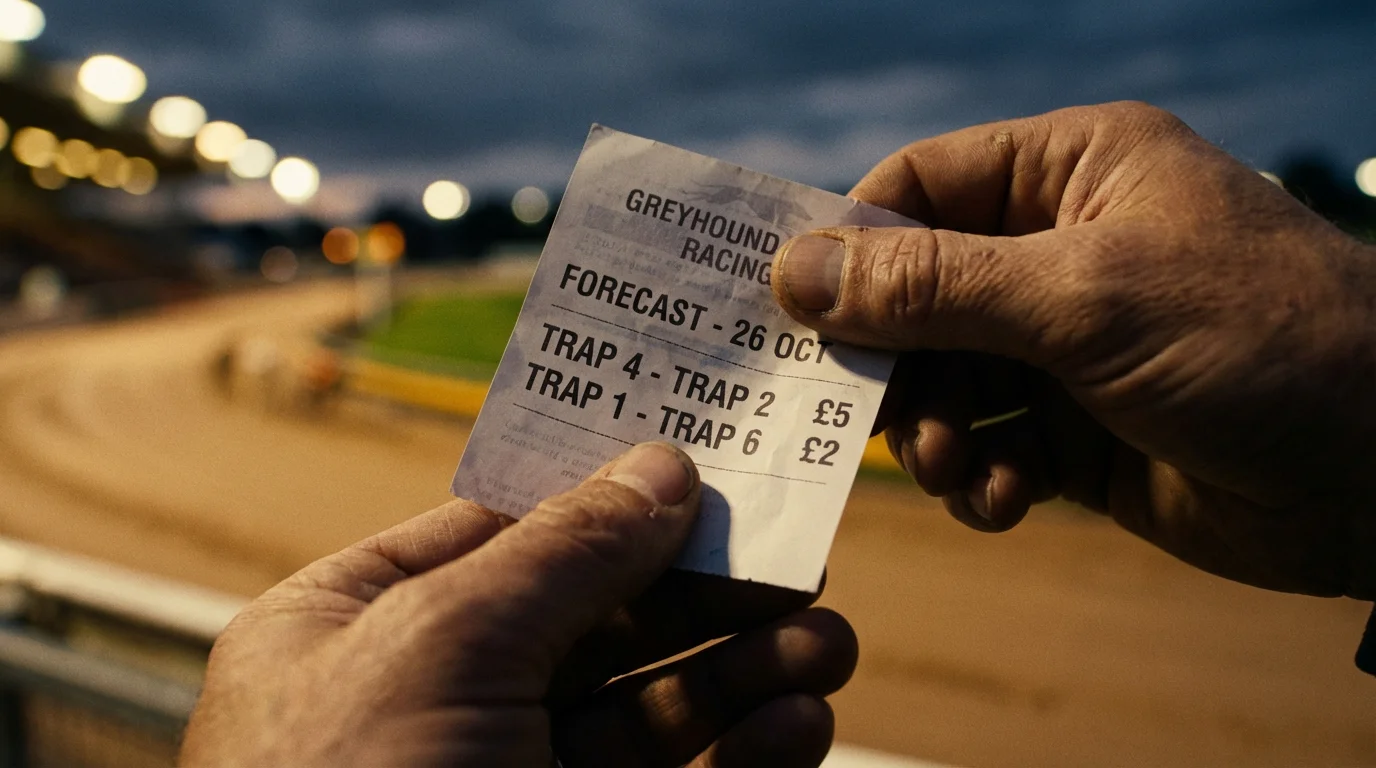
A forecast bet requires you to predict two dogs that will finish first and second in a race. The payout is not determined by fixed odds but by a computer-generated dividend that reflects the difficulty of the prediction based on the starting prices of the dogs involved and the number of runners. This means you do not know your exact return when you place the bet — you know only that correctly predicting an unlikely first-and-second combination will pay substantially more than predicting the obvious one.
The straight forecast — sometimes abbreviated as SFC or CSF (computer straight forecast) — asks you to name the first and second in the correct order. Dog A first, Dog B second. If they finish the other way around, you lose. This is the purest and cheapest form of forecast betting: one selection, one stake, one specific outcome required. The appeal is the payout. Straight forecast dividends in competitive six-dog races routinely return between £20 and £80 for a £1 stake. In open races or lower grades where the form is more chaotic, dividends above £100 from a £1 unit are not unusual.
The reverse forecast covers both possible finishing orders of your two selected dogs. If you pick Dog A and Dog B, you win whether the result is A-B or B-A. The cost is simply double the straight forecast stake, because you are placing two bets — one on each permutation. The reverse forecast is the natural choice when you are confident that two specific dogs will dominate a race but genuinely uncertain about which one prevails. It halves your potential payout per unit stake but doubles your strike rate on the pairing, which over time is usually the better trade.
The combination forecast extends the logic further. You select three or more dogs and cover every possible first-and-second combination among them. With three selections, you have six permutations (A-B, A-C, B-A, B-C, C-A, C-B), so your total stake is six times your unit. With four selections, it rises to twelve permutations. The combination forecast is a broader net, useful in races where the form suggests a small group of three or four dogs should fill the top places but the exact order is genuinely open. The danger is cost creep: as you add selections, the number of permutations grows rapidly and your total outlay can exceed the likely dividend on the more predictable outcomes within the combination.
When do forecasts offer genuine value? The strongest scenarios involve races where you can identify a likely top-two pairing that the market has not fully priced in — perhaps two dogs from the same trainer who have been targeted at this race, or a situation where the trap draw gives a clear structural advantage to two runners and a disadvantage to the rest of the field. In tightly graded races where every dog has similar recent form, the outcome is closer to a coin flip among six, and forecast dividends tend to be modest relative to the difficulty. The skill is in identifying the races where the top two places are more predictable than the market implies, not in spreading forecasts across every race on the card.
How to Calculate Forecast Bet Costs
The cost of a forecast bet depends entirely on the type and the number of selections. For a straight forecast, the cost is simply your unit stake — one bet, one outcome. For a reverse forecast on two dogs, the cost is two units. Beyond that, the arithmetic follows a formula: for a combination forecast, the number of bets equals the number of selections multiplied by one less than the number of selections. Three selections produce six bets. Four selections produce twelve. Five selections produce twenty.
This scaling is worth internalising before you start placing combination forecasts, because it is easy to underestimate the total outlay. A £1 unit combination forecast on four dogs costs £12. If the likely dividend for the most predictable outcome within that combination is £30, your net profit on a winning bet is £18. If you had placed a straight forecast on that specific pairing at £2, the same dividend would have returned £60 for a net profit of £58. The combination gave you broader coverage but at a steep cost in expected value on the most probable outcome.
The practical rule is to use combination forecasts when you genuinely cannot separate two or three dogs and the race conditions suggest the top-two positions will come from that group. Use straight or reverse forecasts when your analysis points to a specific pairing with reasonable confidence. Mixing the two approaches — a straight forecast on your primary pairing plus a smaller-stake combination including a third dog as insurance — is a common technique among experienced greyhound punters that balances conviction with coverage.
Tricast Bets: Predicting the Top Three
The tricast is the highest-variance bet in greyhound racing — and the one that produces the biggest stories.
A straight tricast asks you to predict the first three finishers in exact order. In a six-dog race, there are 120 possible permutations for the top three positions. Getting one of them right from a single selection is, statistically, demanding. But greyhound fields are not random — form, trap draws and running styles create structure within the chaos — and punters who understand that structure can narrow the realistic outcomes to a manageable set. When a straight tricast lands, the dividends reflect the difficulty. Returns of £200 to £500 from a £1 stake are common in competitive graded races. In open events or races with an upset, dividends can run into four figures.
A combination tricast selects three or more dogs and covers every possible first-second-third arrangement among them. With three selections, you have six permutations. With four, you have twenty-four. With five, you are looking at sixty permutations, and your £1-unit combination tricast costs £60. The cost escalation is the primary constraint. Combination tricasts offer peace of mind — you only need your selected dogs to fill the first three places in any order — but that peace of mind comes with a price tag that can easily exceed the dividend if the outcome involves two or more shorter-priced dogs.
The realistic hit rate for straight tricasts, even for sharp punters, sits somewhere below 5% in standard graded racing. That means you need the occasional large dividend to offset long losing runs. This is not inherently a problem — high-variance strategies can be profitable over sufficient sample sizes provided the expected value of each bet is positive — but it demands a bankroll that can absorb extended dry spells. Punters who stake more than 1% of their bank on individual tricast bets tend to find themselves in trouble well before the variance evens out.
The question of when a tricast offers better value than a forecast comes down to the race structure. In a race where two dogs are clearly superior but the third-place finisher is genuinely unpredictable, a forecast on the top two is the cleaner bet — adding a tricast layer just introduces variance without a corresponding increase in expected value. In a race where three dogs stand out from the remaining three on form and class, a combination tricast covering that trio in all six permutations captures a dividend that a forecast cannot access. The key is to let the race dictate the bet type, not the other way around.
Multiple Bets: Accumulators, Trixies, Patents and Beyond
Accumulators are fun — but permutation bets are where experienced punters protect their downside.
A multiple bet combines two or more selections from different races into a single wager. The simplest form is a double — two selections, both must win. The returns from the first winning leg roll into the second as the stake, producing a compounded payout that exceeds what two individual singles would return. A treble adds a third leg. A four-fold adds a fourth. Each additional leg multiplies the potential return and, with equal ruthlessness, multiplies the probability of failure. One loser anywhere in the chain kills the entire bet.
In greyhound racing, accumulators carry a specific appeal and a specific danger. The appeal is velocity: with races running every 12 to 15 minutes at a single meeting, a four-fold accumulator built from one evening card settles inside an hour. You know the result quickly, and the dopamine cycle is compressed into a timeframe that football or horse racing accumulators cannot match. The danger is precisely the same velocity. The speed at which you can build, place and lose accumulators on a greyhound card encourages impulsive betting — adding an extra leg because the next race starts in ten minutes, not because you have a considered opinion on it.
The mathematics of greyhound accumulators are instructive. If you back four dogs each at 2/1, your accumulator returns 80/1 — £80 from a £1 stake if all four win. The implied probability of four independent 2/1 shots all winning is roughly 1.2%. Even allowing for skill in selection that pushes your actual win probability above the market’s implied figure, you are losing this bet the vast majority of the time. Over a long sample, the expected value of accumulators is negative for most punters because the compounding of the bookmaker’s margin across multiple legs erodes the edge faster than compounding odds build the return.
This is where permutation bets offer a structural alternative. Instead of requiring every selection to win, permutation multiples cover multiple combinations of your selections, ensuring you still collect if one or two legs fail. The trade-off is a higher total stake — because you are placing multiple bets within a single slip — but the probability of a return increases meaningfully. For punters who want the excitement of multi-race bets without the all-or-nothing fragility of a straight accumulator, permutation formats offer a middle ground that is genuinely worth understanding.
Permutation Bets: Trixie, Patent and Lucky 15
A Trixie requires three selections and consists of four bets: three doubles and one treble. If two of your three selections win, you collect on one double. If all three win, you collect on three doubles and the treble. The total stake is four times your unit. A Trixie is essentially an accumulator with built-in insurance — you only need two winners from three to see a return, though the return from two winners alone is modest unless the odds are generous.
A Patent takes the same three selections and adds three singles to the four Trixie bets, creating a seven-bet package. Now you collect even if only one selection wins, because the singles pay independently. The downside is cost: seven units of stake for three selections. The upside is resilience — a Patent turns a three-selection multiple from a high-risk gamble into a layered position where even partial success generates a payout.
A Yankee requires four selections and covers eleven bets: six doubles, four trebles and one four-fold accumulator. A Lucky 15 adds four singles to the Yankee, making fifteen bets total. Some bookmakers offer bonuses on Lucky 15 bets — typically enhanced odds if only one selection wins, or a consolation bonus if all four lose. These promotions can shift the expected value meaningfully, making Lucky 15 one of the few permutation bets where the bookmaker’s promotional overlay sometimes creates genuine value.
The common thread across all permutation formats is that they exchange total stake for survivability. You pay more upfront, but your bet can absorb one or two losing legs and still return something. For greyhound punters who want multi-race involvement without the binary win-or-lose dynamic of a straight accumulator, permutations represent a structurally sounder approach — provided the total stake is managed within your session budget.
Special Markets: Trap Challenges, Favourites Index and Tote
Beyond the standard menu, bookmakers offer niche markets that reward a different kind of analysis.
Trap challenges are among the most popular specials in greyhound betting. The format varies by operator, but the core idea is consistent: pick the winning trap number across a series of designated races. Some versions ask you to predict the winning trap in every race at a single meeting; others focus on a set number of consecutive races. The payouts can be substantial because the probability of correctly predicting six or more winning trap numbers in sequence is extremely low. Trap challenges are effectively multi-leg accumulators where your selection is a trap position rather than a named dog, which means they reward punters who track trap bias at specific venues. If you know that trap 1 at Romford wins at an above-average rate, that knowledge has direct application here.
The favourites index — sometimes called “favourite or not” — asks you to predict whether the race favourite will win. Across a meeting of twelve races, you make twelve binary predictions: yes or no for each. Some bookmakers structure this as an accumulator with fixed odds; others offer it as a pool-style bet. The statistical reality is that greyhound favourites win around 30 to 35 percent of races, so the favourites index is essentially a test of how well you can identify which races are likely to produce a favourite winner and which are competitive enough to produce an upset.
Tote and pool betting operates on a parimutuel basis rather than fixed odds. Your stake goes into a pool with all other bets on the same market, and the total pool is divided among winning tickets after the operator’s deduction. Tote win, tote place, exacta (the pool equivalent of a forecast) and trifecta (the pool tricast) are the standard formats. The attraction of pool betting is that dividends are determined by co-punters’ money rather than bookmaker pricing, which occasionally produces payouts that exceed what fixed-odds markets would have delivered — particularly in races where the tote pool is small and the result catches the majority of pool bettors on the wrong side. The weekly Pick 6 and daily doubles at certain tracks offer jackpot-style payouts that accumulate until someone wins, creating occasional large prize pools from modest individual stakes.
Which Bet Type Suits Your Approach?
Bet type should follow strategy, not replace it.
The mistake most punters make is treating bet types as strategies in themselves. “I’m a forecast punter” or “I only do accas” are statements about preference, not about method. The bet type is a vehicle. The strategy is the route. Choosing the right vehicle depends on what the race in front of you looks like, not on what worked last Tuesday or what feels most exciting.
If your analytical strength lies in identifying outright winners — reading form, sectional times and trap draw to find the most probable first-past-the-post — then win singles are your primary instrument and each-way bets are your secondary. This is the lowest-variance, highest-frequency approach, and it suits punters who want to bet regularly with controlled risk. If your strength is in ranking fields — determining not just who will win but who will fill the places — then forecasts and occasional tricasts become viable additions. The analytical overhead is higher, but so is the ceiling on individual returns.
Accumulators and permutation bets sit in a different category. They are not driven by deeper analysis of individual races but by a willingness to compound risk across multiple events. For punters with an edge in selection, short doubles on carefully chosen races can be a reasonable use of that edge. For punters without a demonstrated edge, accumulators are a fast way to turn a controlled session into an expensive one. Knowing which category you fall into requires honest record-keeping over a meaningful sample, which most punters never bother to do.
Special markets — trap challenges, tote pools, favourites index — serve a recreational function for most bettors. They are side dishes, not main courses. If you have specific knowledge of trap bias at a venue, a trap challenge can exploit that knowledge in a way that standard markets do not. If you enjoy the communal aspect of pool betting, tote formats offer a different flavour. But building a core strategy around specials is rarely productive, because the markets are either too thin, too high-variance, or too dependent on factors beyond your control.
Know the Menu Before You Order
The punter who uses three bet types well will outperform the one who dabbles in ten.
Greyhound racing offers a wider range of betting options than most punters ever explore, and there is value in understanding the full spectrum — not because you should use every format, but because understanding what exists helps you recognise when each one is appropriate. A race with two standout dogs and four no-hopers is a forecast opportunity. A race with three closely matched contenders and an unpredictable third-place finish is a tricast scenario. A meeting where you fancy three strong selections across different races is a Trixie, not a treble, if you want survivability. These are not arbitrary distinctions. They are the difference between a bet that matches the race conditions and one that fights them.
The temptation in greyhound betting — amplified by the pace of meetings and the constant availability of the next race — is to default to the same bet type regardless of what the card presents. Win single every time. Or acca every meeting. Or forecast as a reflex. Defaulting is comfortable, but comfort is not the same as effectiveness. The punters who extract the most value from greyhound racing are the ones who read each race on its own terms and select the bet type that fits the opportunity, not the one that fits their habits.
Start with win singles until your racecard reading is solid. Add each-way bets when you can identify value at longer prices. Introduce forecasts when you develop the ability to rank fields rather than just pick winners. Leave tricasts and permutation bets for the specific scenarios that justify them. And treat specials as exactly that — special occasions, not the default order. The menu is long. Your strategy should keep you on the dishes you prepare best.