Weather and Track Conditions in Greyhound Racing
Best Greyhound Betting Sites – Bet on Greyhounds in 2026
Loading...
The Factor Hiding in Plain Sight
Greyhound racing takes place outdoors, on sand, in whatever weather the British climate delivers. Rain, wind, temperature and seasonal variation all affect the track surface, and the track surface affects how every dog in the race performs. Yet most punters analyse form, study trap statistics, compare sectional times — and completely ignore the conditions under which those data points were produced. A time of 29.40 seconds on fast, dry sand and a time of 29.40 on rain-soaked heavy going represent two entirely different levels of performance. Treating them as equivalent is an analytical error that compounds across every race.
Conditions analysis is not complicated. It does not require meteorology expertise or specialist equipment. It requires checking the weather forecast before betting, understanding how different surface states affect different types of dog, and adjusting your form assessment accordingly. The punter who does this has an advantage over every competitor who does not — and most do not.
Wet Conditions: Heavy Going and What It Means
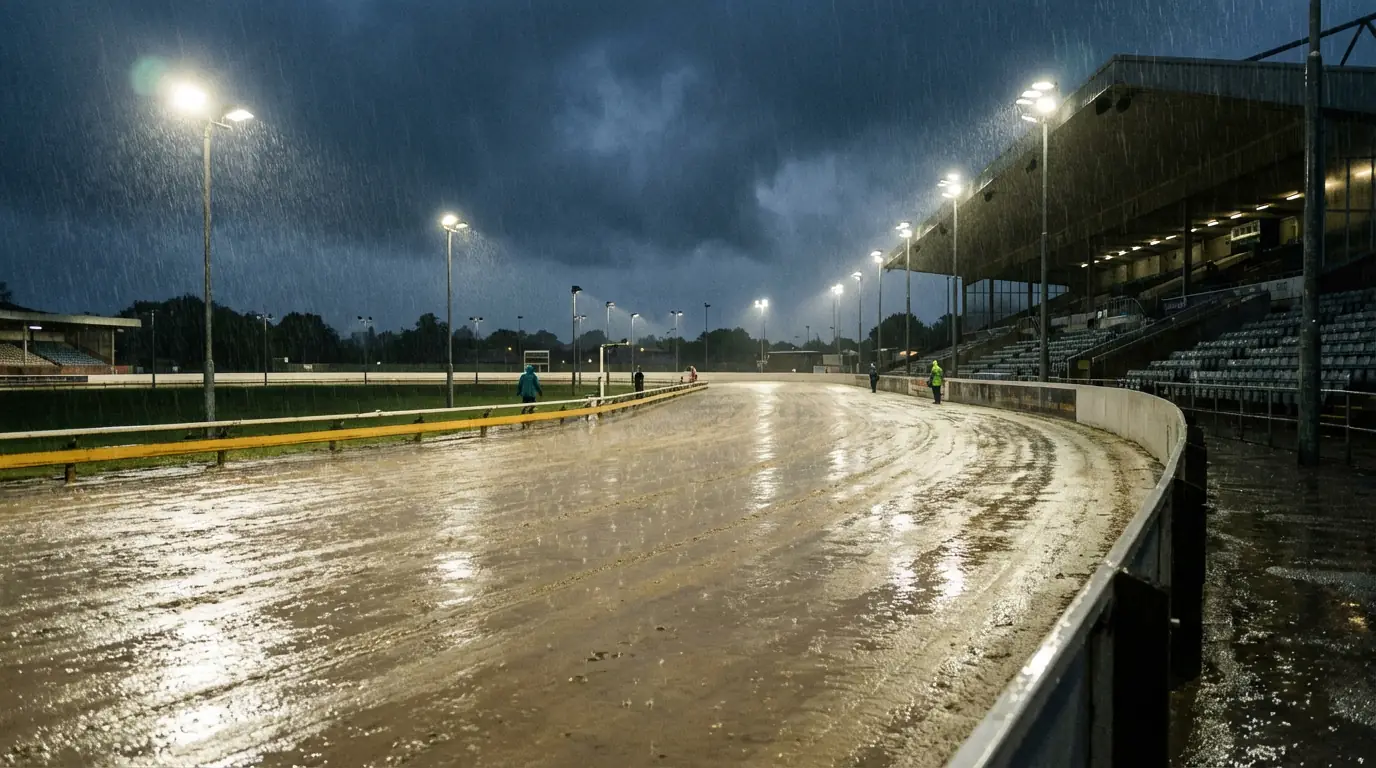
Rain is the single most significant weather variable in UK greyhound racing. When rain falls on a sand track, the surface changes. Light rain can actually speed the surface up slightly — dampening loose sand into a firmer, faster running base. But sustained or heavy rain saturates the track, producing heavy going that slows times, increases physical demands, and changes the competitive balance between dogs.
On heavy going, raw speed matters less and physical power matters more. A lean, light dog that flies on fast sand may struggle to maintain pace through a surface that saps energy with every stride. A heavier, more powerfully built dog — one that looks ordinary in good conditions — can grind through the heavy ground and finish ahead of faster rivals who have emptied their reserves. The parallel with horse racing is direct: some horses act on soft ground, others do not. The same principle applies to greyhounds, though it receives far less public attention.
Dogs that handle wet conditions tend to share certain physical characteristics: slightly heavier build, strong hindquarters, and a running style that does not depend entirely on explosive acceleration. Closers and staying types often perform better in the wet because the surface neutralises the early-speed advantage of leaders — the faster dogs cannot separate from the field as easily on heavy sand, and the race compresses into a pack affair that suits the dog with reserves.
Trap statistics shift on wet tracks. The inside-rail advantage that dominates on dry sand can be reduced or even reversed in wet conditions if the rail becomes churned up from repeated use. The inside lane carries more traffic across a meeting, and on a wet day the sand near the rail may become heavier and slower than the ground further out. At some tracks, this produces a measurable shift in trap performance during a wet meeting — trap 1 win rates fall, outer traps improve. Monitoring how track conditions evolve during a meeting, not just at the start, is a useful habit.
Form produced in wet conditions should be annotated in your records. If a dog posted a slow time at its last run but the going was heavy, that time may understate the dog’s true ability. Equally, a fast time recorded on an unusually quick, rain-firmed surface may overstate it. The time is only meaningful when paired with the conditions under which it was run.
Dry Conditions: When the Sand Flies
Extended dry weather produces fast, loose sand that favours speed over power. Times drop, leaders stretch the field, and the gap between the first bend and the rest of the field widens. In these conditions, dogs with explosive trap breaks and high peak speed are at their most dangerous. The surface offers minimal resistance, early pace converts directly into distance, and closers find themselves with too much ground to make up in the finishing straight.
Very dry sand can become deep and loose, particularly at tracks that have not been watered between races. In extreme cases, deep sand behaves similarly to heavy going — it absorbs energy and slows the dogs, but through a different mechanism (lack of traction rather than surface weight). Track maintenance staff manage this through watering and harrowing between races, but the quality of maintenance varies between venues and across different times of day. Early-card races at an afternoon meeting may be run on freshly prepared sand; later races may encounter a surface that has deteriorated through use.
Wind deserves mention alongside dry conditions. Greyhound tracks are typically exposed, with low surrounding structures that offer little shelter. A strong headwind on the finishing straight slows every dog but disproportionately affects those with lighter builds and less momentum. A tailwind can produce artificially fast times that look impressive on paper but do not reflect true ability. Wind conditions are rarely reported on racecards or bookmaker platforms, but a quick check of the local forecast before betting on an exposed track is a thirty-second investment that occasionally reveals something useful.
Seasonal Patterns: Summer, Winter and the Twilight Card
UK greyhound racing runs year-round, but the seasons produce different racing conditions that affect performance in systematic ways. Summer racing, particularly afternoon BAGS meetings, takes place in warmth and usually on fast, dry or watered sand. Dogs run faster times, the surface is consistent within a meeting, and the conditions favour speed. Summer form tends to be the most reliable for direct comparison, because the variables are fewer and the track state is more predictable.
Winter racing introduces cold temperatures, shorter daylight hours, and more frequent rain. Times slow across the board — not because the dogs are less talented, but because the surface is heavier and the cold reduces muscle efficiency. Comparing a dog’s November time directly with its July time is misleading unless you adjust for the seasonal difference. A drop of 0.20 to 0.50 seconds between summer and winter is normal and expected at most UK tracks.
Evening meetings present their own micro-climate. As the sun sets and temperatures drop, the track cools and the surface can firm up or soften depending on whether the afternoon was wet or dry. Dogs running on the last few races of an evening card may encounter a materially different surface to those that raced in the early races. This within-meeting variation is subtle but real, and it affects the reliability of time comparisons between early and late races on the same card.
Seasonal patterns also affect the dog population. Some trainers rest their best dogs during the winter months, saving them for the spring and summer competition season. The quality of BAGS fields in January may be marginally weaker than in June. Others use winter racing to build fitness for major competitions. Understanding these patterns at your chosen track — which kennels are active in which months, which dogs appear in winter and which are rested — adds context to seasonal form that the bare numbers cannot provide.
Checking Conditions and Adjusting Your Analysis
Before betting on any greyhound meeting, check two things: the weather forecast for the track location and the going report if one is available. Most bookmaker platforms do not display going conditions for greyhound racing the way they do for horse racing, which means you need to look elsewhere — local weather forecasts, track social media accounts, or simply noting the conditions on the live stream if you are watching the early races before betting on later ones.
When the going is notably different from a dog’s recent form conditions, adjust your assessment. A dog whose last three runs were on fast summer sand is now racing in November on rain-affected ground. Its times will be slower. Its running style may be less effective. Its physical profile may or may not suit the heavier surface. These adjustments are not precise — you cannot calculate exactly how many lengths a dog loses on heavy ground — but they are directionally correct and that is enough to improve your selections over time.
Conditions Are Free Information
Weather and track conditions are the most accessible and least utilised variable in greyhound betting. The information is free — a weather forecast takes seconds to check. The impact is real — conditions affect times, running styles, trap statistics and competitive balance. And the market, for the most part, ignores it. Bookmakers price greyhound races primarily on form and market demand. If the form was produced in conditions different from today’s, the price may not reflect the actual probability of the outcome. That gap is yours to exploit, and it costs nothing but attention.