Understanding Greyhound Running Styles: Railers, Closers and Leaders
Best Greyhound Betting Sites – Bet on Greyhounds in 2026
Loading...
Running Style Is the Variable Most Punters Ignore
Every greyhound has a preferred way of running a race. Some dogs break fast from the traps and lead from the front. Others settle into mid-pack and close down the leader in the final straight. Some hug the inside rail regardless of their trap draw. Others drift wide on every bend, covering extra ground but running in clear air. These tendencies are consistent, observable and — critically for the punter — predictable. A dog that has led at the first bend in its last five races is overwhelmingly likely to attempt the same approach in its next one.
Running style matters because it determines how a race unfolds. When two leaders are drawn in adjacent traps, they compete for the same early position, increasing the chance of interference at the first bend. When a closer is drawn behind a clear leader with no other early-pace dogs in the race, the leader may coast to an unchallenged win. The interaction between running styles — not just the talent of individual dogs — shapes the outcome. A punter who reads the racecard for speed and form but ignores how each dog actually races misses a layer of analysis that directly affects finishing order.
Identifying running styles requires watching races, reading race comments, and studying sectional times. The data is available. The question is whether you use it.
Leaders: The Dogs That Win From the Front
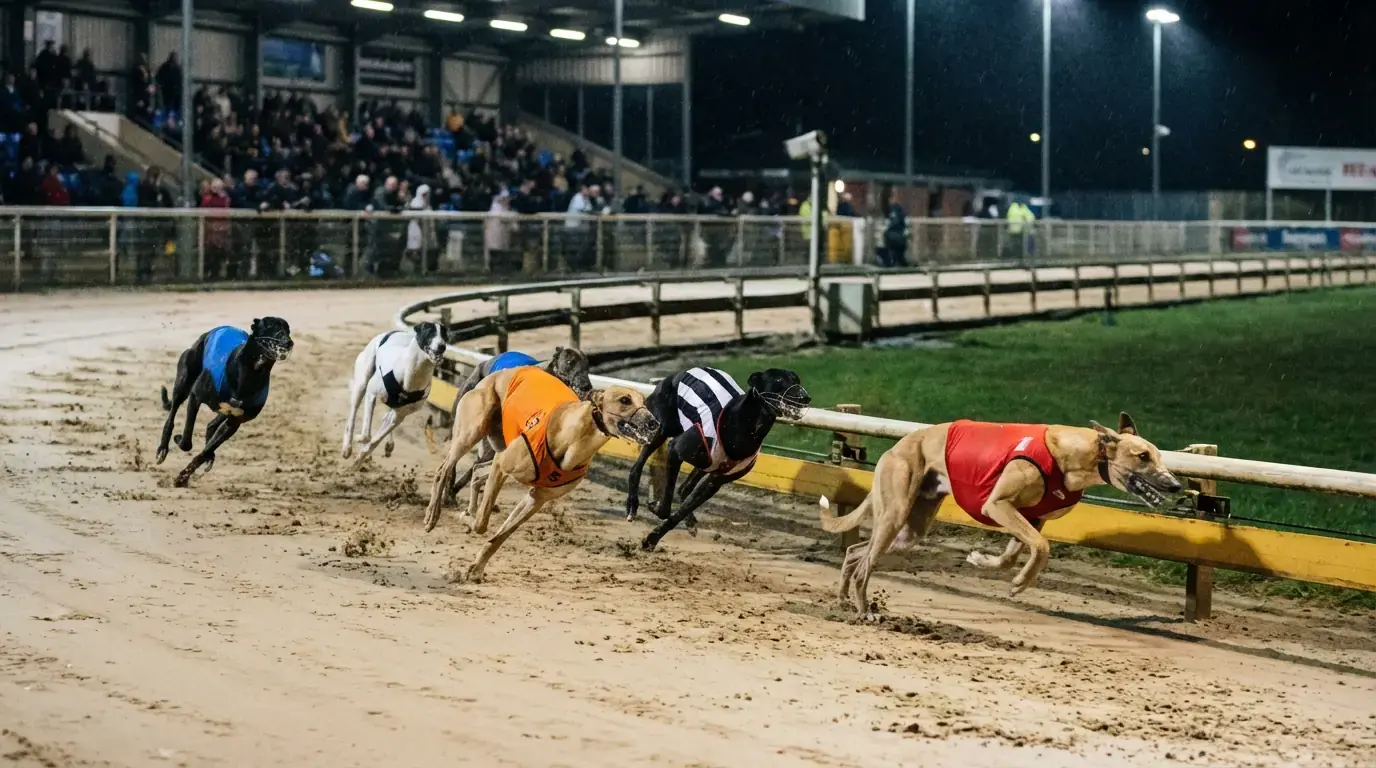
Leaders — also called front-runners or pace dogs — are greyhounds with fast trap breaks and high early speed. They aim to reach the first bend ahead of the field, claim the rail, and maintain that position to the line. In UK greyhound racing, leading at the first bend is the single strongest predictor of winning the race. Data across multiple tracks consistently shows that the dog leading at the first bend wins more than 40 per cent of the time — a massive advantage in a six-runner contest.
The leader’s advantage is partly geometric and partly tactical. Geometrically, the dog on the inside rail travels the shortest possible distance around every bend. Over a standard 480-metre race with two bends, the rail runner covers measurably less ground than a dog running one or two widths off the rail. Tactically, the leader runs in clean air with no dog in front to check its stride. It sets the pace, controls the race, and forces every other runner to either match its speed or find a way past — both of which cost energy and position.
For betting, leaders are most valuable when their early pace is uncontested. If the racecard shows only one dog with genuinely fast sectional times, that dog is likely to lead unchallenged. In this scenario, the leader’s win probability is higher than the market typically prices in, because the absence of pace competition removes the primary risk factor — first-bend interference. Conversely, when two or three dogs in the same race have similarly fast sectionals, the leaders cancel each other out. They compete for the same space at the first bend, increasing the chance of crowding and creating opportunities for mid-pack dogs to inherit the race.
Trap draw is inseparable from leading style. A leader drawn in trap 1 has the shortest route to the rail and the highest probability of establishing position. A leader drawn in trap 5 or 6 must either cross the field to find the rail — risking interference — or accept running wide through the first bend, negating much of the early-speed advantage. When assessing a leader, always cross-reference its sectional time with its trap draw. The combination of the two, not either alone, determines the probability of a successful front-running performance.
Closers: Winning From Behind
Closers are greyhounds that lack explosive early speed but possess strong sustained pace and finishing power. They typically settle in the middle or rear of the field through the first bend, conserve energy while others battle for position, and then accelerate through the second bend and finishing straight to overhaul tiring leaders. The closer’s weapon is stamina, not acceleration.
Closers win less often than leaders in greyhound racing — the maths favour the front-runner in a sport where races are short and the first bend is decisive. But when closers do win, the circumstances are usually identifiable in advance: a race with multiple leaders who are likely to interfere with each other, a longer distance that rewards late pace, or a track configuration where the finishing straight is long enough for a strong closer to make up ground.
Standard 480-metre races with two genuine leaders and a proven closer in the field are the classic setup. The leaders battle at the first bend, one or both lose momentum, and the closer — running in clear air behind the carnage — arrives at the second bend with energy to spare. This scenario is not speculative. It is a recurring pattern that produces upset results and generous dividends, because the market tends to price leaders more aggressively than closers, regardless of the pace dynamics.
Distance suitability amplifies the closer’s prospects. Over 640 metres or more, the staying trip gives closers additional ground over which to deploy their late pace. Sprint races, conversely, are nearly impossible for closers to win — there is simply not enough track to make up the early deficit. When a known closer is entered in a sprint, the form figures are almost irrelevant. The distance kills the running style before the race begins.
Railers and Wide Runners: The Track Geometry Factor
Independent of early pace, greyhounds tend to run either on the inside rail or wide of it. This preference — railer or wide runner — is a separate variable from leader or closer, and the two can combine in any configuration. A dog can be a leader that rails, a leader that runs wide, a closer that rails, or a closer that runs wide. Each combination produces different race dynamics.
Railers are dogs that naturally gravitate toward the inside rail. They seek the shortest path around every bend and benefit from the geometric advantage that the rail provides. A railer drawn in trap 1 is in its ideal position — the rail is immediately accessible from the inside trap. A railer drawn in trap 5 faces a dilemma: cross the field at the first bend to find the rail, risking interference, or accept running wider than preferred for the first part of the race.
Wide runners take bends on the outside, covering more ground but avoiding the congestion that develops on the rail through the first and second bends. At tracks with tight bends, rail congestion can be severe — dogs checking, bumping and losing momentum as they compete for the inside line. A wide runner avoids all of this, trading distance for a clear run. At tracks where the bends are tight and crowding is frequent, wide runners can outperform railers despite covering extra metres.
Track suitability is the key variable. Some tracks produce heavy rail traffic because the bends are sharp and the run to the first bend is short, funnelling dogs into a narrow space. At these venues, wide runners thrive. Other tracks have sweeping bends and long straights that reward rail runners with minimal congestion risk. Knowing which tracks favour railers and which favour wide runners — and matching that knowledge to the running style of each dog in the field — is a layer of analysis that most casual punters never reach.
Factoring Style Into Your Selections
Running style analysis starts with a simple question for each dog in the race: does this dog lead, close, rail or run wide? The answers come from sectional times (fast sectionals indicate leaders), race comments (descriptions like “railed throughout” or “finished strongly wide”) and visual observation from watching live or streamed races.
Once you have categorised each dog, map the styles against the trap draw. If two leaders are drawn in traps 1 and 2, expect a first-bend battle. If the only leader is in trap 1 with no other early-pace dogs, expect a controlled front-running performance. If a proven closer is drawn in trap 6 behind a field of leaders, expect the closer to pick up the pieces when the pace collapses.
These projections are not certainties. Dogs do not always run to type, traps do not always break cleanly, and races do not always follow the script. But running style is one of the most consistent behavioural traits in greyhound racing — far more consistent than finishing position, which depends on opposition quality. A dog leads because it has the speed and the instinct to lead, and that does not change from race to race. Building that consistency into your analysis does not guarantee winners, but it sharpens the probability assessment on every race you bet on.
The Race Within the Race
A greyhound race is not six dogs running independently toward a finish line. It is six running styles interacting with a specific track geometry and a specific trap draw. The leader from trap 1 controls the rail. The closer from trap 6 waits for the bend to sort itself out. The railer from trap 3 looks for a gap. The wide runner from trap 4 swings out and runs clean. These interactions — not just individual ability — determine who crosses the line first. The punter who sees the race as an interaction, not a lottery, sees more than the odds suggest.