UK Greyhound Racing Tracks: Venues, Distances and Stats
 Available in US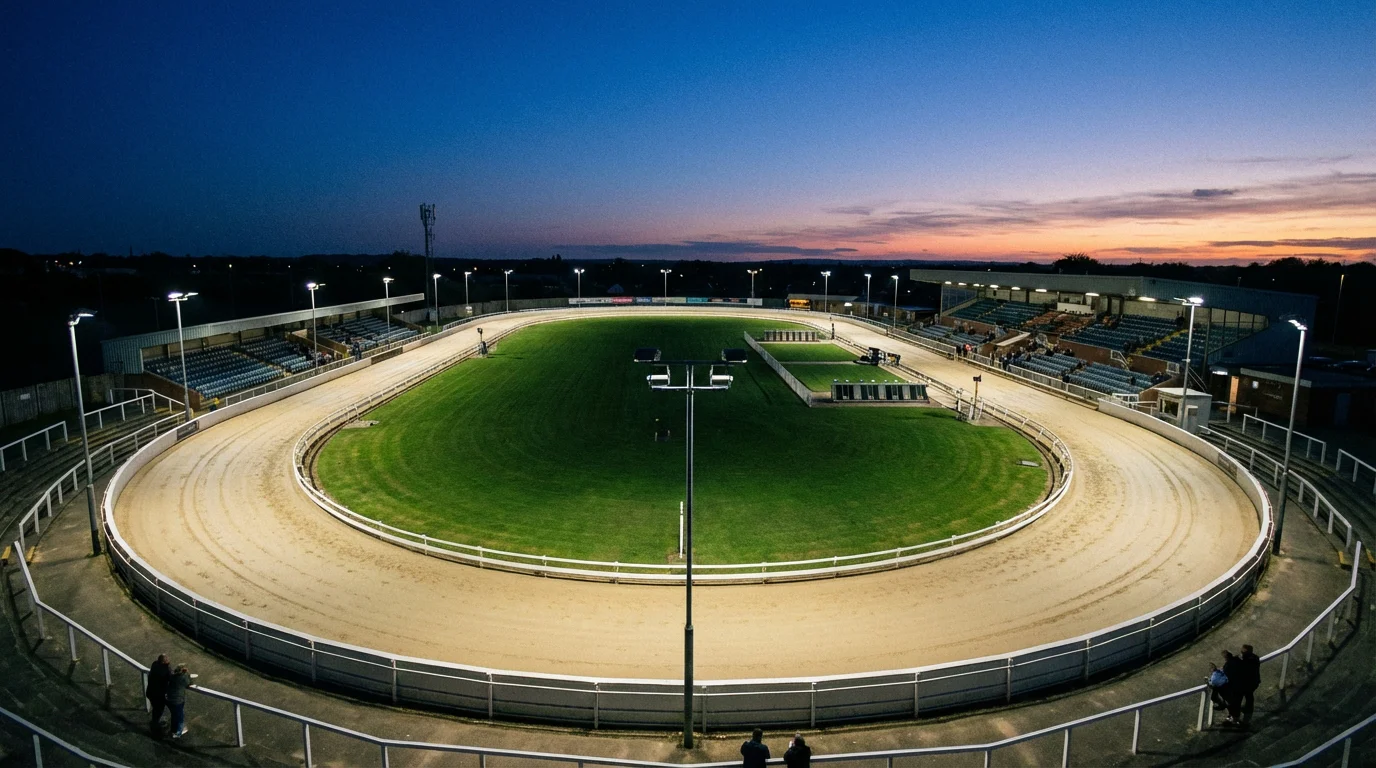
Every Track Has a Personality — Learn It Before You Bet
A dog that wins at Romford might struggle at Towcester — and the track is the reason.
Greyhound racing in the UK operates across a network of licensed tracks regulated by the Greyhound Board of Great Britain (GBGB). Each venue has its own geometry: the circumference of the circuit, the distance to the first bend, the width of the running surface, the camber of the turns, the length of the finishing straight. These are not cosmetic differences. They determine which running styles prosper, which trap draws carry an advantage, and which form lines from other tracks transfer reliably.
A tight, sharp-bended track like Romford favours early-pace dogs drawn on the inside who can establish the rail position before the first turn. A wider track with a long run to the first bend gives wider-drawn dogs more time to find position without covering excess ground. A track with a particularly long home straight rewards closers who can finish strongly after the final bend. None of these characteristics are secrets — they are structural features that repeat across every meeting — yet the majority of casual punters bet on greyhounds without adjusting their analysis for the specific venue. They treat a race at Crayford and a race at Monmore as interchangeable, when in practice the same dog can look like a different animal depending on where it runs.
Understanding UK tracks is not about memorising an encyclopaedia of statistics. It is about recognising that track knowledge is a genuine analytical edge, one that compounds with experience and pays dividends precisely because so many bettors neglect it. This guide covers every active region of UK greyhound racing, the distances available, the trap biases that data reveals, and the conditions that shift the playing field from one meeting to the next.
Check the race calendar for fixtures at these tracks in greyhound racing calendar.
London and South-East Tracks: Romford, Crayford, Hove
The London circuit sees the highest volume of BAGS racing — and the sharpest prices.
Romford is the defining track of the London greyhound scene. Situated in east London, it runs both BAGS daytime meetings and evening cards, making it one of the most frequently raced venues in the country. The track itself is compact — a tight oval with sharp bends and a relatively short run to the first turn. This geometry heavily favours inside-drawn dogs with fast early pace. A dog breaking cleanly from trap 1 or 2 at Romford can establish the rail before the first bend and hold it, forcing wider-drawn dogs to cover extra ground on every turn. The standard distances are 225, 400 and 575 metres, with the 400-metre sprint being the most commonly run. Form from Romford tends to be reliable within the venue, but less transferable to wider tracks where the tight-rail advantage disappears.
Crayford sits in south-east London and offers a different profile. The track is flatter and less sharply bended than Romford, with a longer run to the first turn that gives middle-drawn dogs a fairer chance. Standard distances at Crayford are 380, 540 and 714 metres. The 380 is a genuine sprint where early pace is decisive; the 714 is a staying trip that tests stamina in a way that few other London tracks can. Crayford runs a high volume of BAGS meetings and is known for competitive grading — the dogs are tightly matched, which makes tipping winners harder but forecasts and tricasts more rewarding when they land. For punters specialising in one track, Crayford offers the combination of volume, competitive fields and relatively predictable trap patterns that allows consistent data collection.
Hove, on the Sussex coast near Brighton, is the premier track in the wider South-East and arguably the most respected venue outside of major event hosts. The track is wider than both Romford and Crayford, with sweeping bends that reduce the inside-draw advantage and allow bigger, more powerful dogs to run their natural lines without being squeezed. Distances at Hove include 285, 515 and 695 metres. The 515-metre standard trip is slightly longer than the 480 at most other tracks, which means time comparisons require adjustment. Hove is also a regular host of open races and invitational events, attracting higher-quality dogs than typical graded cards. For bettors, Hove’s wider geometry means that running style analysis matters more than pure trap-draw statistics — a strong closer drawn in trap 5 has a better chance here than at almost any other South-East track.
Midlands and North: Monmore, Perry Barr, Sheffield, Nottingham
Monmore and Perry Barr are workhorse tracks — high volume, competitive grading.
Monmore Green in Wolverhampton is one of the busiest greyhound tracks in the country. It runs BAGS meetings multiple times per week and hosts a steady stream of graded and open racing. The track is medium-sized with a configuration that gives inside traps a noticeable edge, particularly over the standard 480-metre distance. The grading at Monmore is tight, producing fields where the difference between first and sixth on the racecard is often marginal. This makes it a challenging venue for win betting but a productive one for forecast punters who can identify the subtle edges — a dog stepping down in grade, a trap draw that suits its running style, a trainer in a purple patch.
Perry Barr in Birmingham sits just a few miles from Monmore but plays differently. The track is slightly larger with wider bends, which means the inside-trap advantage is less pronounced than at Monmore. Perry Barr has historically been a strong venue for open races and has hosted rounds of major competitions. Its distances include 480 and 630 metres, with the 630 offering a middle-distance test that suits dogs with a combination of pace and stamina. For bettors, Perry Barr’s key characteristic is its competitive grading system, which ensures that even lower-grade races feature dogs of similar ability — a structure that rewards careful form analysis over simple class assessment.
Sheffield is the northernmost of England’s major tracks and one with a distinctive character. The Don Valley Stadium complex houses a track that is both wide and demanding, with long bends that test a dog’s ability to hold its line under pressure. The standard distance is 480 metres, with sprints at 280 metres and a staying trip at 660 metres. Sheffield’s racing tends to attract a loyal local following, and the betting market can be thinner than at London or Midlands tracks — which occasionally means that mispriced runners go underbet. For a punter willing to specialise, Sheffield’s combination of competitive racing and less efficient pricing creates a niche worth exploring.
Nottingham is one of the larger circuits in the country and hosts a regular schedule of BAGS and evening meetings. The track offers multiple distances including a 730-metre trip that tests stamina. Nottingham has also been selected to host the Greyhound St Leger in 2025 as a one-off while the racing operation transfers from Perry Barr to the new Dunstall Park facility in Wolverhampton (GBGB). The St Leger — the premier stayers’ classic — was previously held at Perry Barr over 710 metres from 2017 to 2024, having earlier been staged at Wembley (1928–1998) and Wimbledon (1999–2016). Dogs that excel at Nottingham over staying distances often struggle at shorter trips elsewhere, and vice versa. This distance specialisation makes Nottingham form particularly valuable when assessing stayers, but less useful as a predictor for standard 480-metre races at other venues.
Other UK Tracks: Towcester, Sunderland, Kinsley and Beyond
Beyond the big names, smaller tracks offer thinner markets — and sometimes better value.
Towcester in Northamptonshire holds a unique position in UK greyhound racing as the host of the English Greyhound Derby, the sport’s most prestigious event (GBGB). The track itself is one of the largest in the country — a sweeping circuit that heavily favours strong galloping types over quick, sharp dogs that thrive on tighter tracks. The run to the first bend is long enough that trap draw matters less here than at Romford or Monmore, which reshuffles the dynamics that punters familiar with smaller tracks might take for granted. Towcester also offers hurdle racing, a niche within greyhound racing that has its own following and its own betting angles. Form from Towcester is track-specific to an unusual degree; a dog’s performance here is a poor predictor of how it will run at a compact urban venue.
Sunderland in the North-East provides regular BAGS racing on a track that is straightforward in geometry but competitive in grading. It is a useful venue for punters in the northern regions who want a track to specialise in, partly because the betting market is often thinner than at higher-profile venues. Thinner markets mean less informed money shaping the odds, which in turn means that a punter with genuine local knowledge — who follows the regular runners, knows the trap biases, tracks the trainer patterns — can occasionally find prices that would not survive in the more liquid markets at Romford or Hove.
Kinsley in West Yorkshire, Central Park in Sittingbourne, and the remaining licensed tracks each have their own characteristics, but the common thread for bettors is the same: smaller venues tend to have less media coverage, less analytical attention, and less money in the market. All three of those factors work in favour of the prepared punter. The dogs are no less competitive, the grading no less structured, and the racing no less genuine. What changes is the efficiency of the market. At a high-profile track, the odds are shaped by thousands of opinions and the price you see is close to the collective assessment of the dog’s chance. At a smaller venue, the odds may be set by a handful of large bets and a bookmaker’s algorithm, leaving more room for a well-informed individual to find value.
Race Distances Across UK Tracks
Standard distance is 480 metres — but nothing about a sprint and a stayer’s race is standard.
UK greyhound racing organises its races into four broad distance categories, each of which tests different attributes and produces different betting dynamics. Sprint races, typically run over distances between 210 and 400 metres depending on the track, are raw tests of acceleration and trap-break speed. The race is often decided in the first few seconds. A dog that exits the traps cleanly and leads to the first bend has a dominant advantage, because the short distance allows almost no time for a slower starter to recover ground. Trap draw is at its most influential in sprints — inside positions at tight tracks can be worth several lengths of advantage before the dogs even reach the first turn.
Standard-distance races at 480 metres represent the bread and butter of UK greyhound racing. The majority of graded and BAGS races are run at this trip, which balances early pace with mid-race positioning and a meaningful finishing straight. At 480 metres, dogs typically navigate two full bends, and the race lasts approximately 29 to 31 seconds depending on the track and conditions. This distance is long enough for a dog with strong closing pace to overcome a poor start, but short enough that front-runners are not caught as often as they might be over staying trips. Form analysis at the standard distance benefits from the largest available dataset, because more races are run at 480 metres than at any other trip.
Middle-distance races, generally between 600 and 660 metres, occupy a transitional zone. They require the same early pace to negotiate the first bends cleanly, but add a third bend and a longer run-in that tests stamina in a way that 480-metre races do not. Dogs that dominate at standard distances sometimes struggle to sustain their effort over the extra ground, while natural middle-distance types may look pedestrian in shorter races but come alive when the trip stretches. For bettors, middle-distance form from the same track is the most reliable predictor — the gap between standard and middle-distance performance is large enough that recent results at 480 metres should not be trusted as the primary guide for a 660-metre race.
Staying races at 700 metres and above — including the 700-metre and 730-metre trips at Nottingham and the marathon distances at some other venues — are the endurance tests of the greyhound world. These races involve multiple bends, sustained pace and a level of tactical positioning that shorter races rarely require. Stayers are often identifiable from their running style: they tend to settle in mid-pack during the early stages, conserve energy through the middle of the race, and produce their strongest effort in the closing stages. Betting on staying races rewards patience in analysis. The form book is thinner because fewer races are run at these distances, but the dogs that specialise in them tend to be consistent — their stamina is a physical attribute rather than a form fluctuation.
Hurdle races, offered at a handful of venues including Towcester, add a further dimension. Dogs must clear low hurdles during the race, which changes the dynamics entirely. Some dogs take to hurdles naturally; others lose momentum at every obstacle. Hurdle form is virtually its own discipline, and bettors should treat it as such — flat form is a secondary indicator at best when a dog lines up over hurdles.
Trap Statistics by Track: Where Bias Lives
Trap bias is not a theory — it is a measurable structural feature of greyhound racing, and it varies from track to track in ways that directly affect your betting.
In a perfectly neutral race, each of the six traps would produce a winner approximately 16.7% of the time. In reality, no UK track operates at that equilibrium. The geometry of the circuit — the distance to the first bend, the width of the track, the tightness of the turns — creates persistent advantages for certain trap positions. These advantages show up clearly in historical data and they persist across seasons because the track geometry does not change.
At tight, compact tracks, the inside traps tend to dominate. Trap 1 at Romford, for example, wins at a rate consistently above the 16.7% baseline across all distances. The reason is mechanical: the inside runner has the shortest path to the first bend and can establish the rail position with the least amount of effort. Dogs in traps 5 and 6 need to cover more ground to reach the same point on the track, and at a tight venue they are often forced wide on the first bend, losing further ground to the leaders. Over hundreds of races, this structural disadvantage translates into a lower win rate that no amount of individual dog quality can fully overcome.
At wider tracks with longer runs to the first bend, the picture changes. Hove, for instance, shows a much more even distribution across trap positions, because the wider geometry gives outside-drawn dogs more time and space to find their running position before the first turn. At some tracks, specific outside traps actually outperform the inside — a phenomenon that usually reflects a bend configuration or running rail placement that channels wider-drawn dogs into a more efficient racing line once the field settles.
The distance of the race also modifies trap bias within a single track. A sprint over 280 metres at Sheffield may show a strong trap 1 bias, because the race is essentially a drag to the first bend and the shortest path wins. Over 660 metres at the same track, the extra bends and the longer race allow the field to sort itself out, and the trap-1 advantage diminishes as other factors — stamina, racing line, closing pace — become more influential. Punters who use trap statistics without filtering by distance are working with blurred data.
Where trap bias becomes genuinely valuable is at the intersection of statistical evidence and individual race assessment. Knowing that trap 3 at Monmore wins at 19% over 480 metres is useful context. Knowing that trap 3 at Monmore wins at 19% and the dog drawn there tonight is an improving A4 with fast sectional times and a trainer in form — that is an edge. The statistics provide the structural backdrop. Your analysis of the specific field provides the foreground. Neither one is sufficient alone. Together, they produce assessments that are more accurate than either the market’s consensus or your unaided judgment.
How to Apply Trap Data to Your Betting
The practical application of trap data follows a three-step process that integrates with — rather than replaces — your broader form analysis.
First, establish the baseline. For the track and distance you are betting on, know the historical win rate for each trap position. This data is available through several free greyhound racing statistics services and is updated regularly. The baseline tells you which traps carry a structural advantage at that specific venue and trip. It does not tell you who will win tonight, but it sets expectations that your individual-race analysis can then adjust.
Second, overlay the baseline onto your racecard reading. If your form analysis identifies a strong contender drawn in a trap that historically underperforms at this track and distance, that is a flag — not a disqualification, but a reason to be more cautious. The dog may well overcome the trap disadvantage if it is significantly superior on form, but the structural headwind should be reflected in a smaller stake or a pass if the odds do not compensate for the added risk. Conversely, a dog whose form is solid but not spectacular, drawn in a trap that consistently outperforms, deserves a closer look. The trap bias acts as a tailwind that the market may not have fully priced in.
Third, avoid the trap of treating statistics as deterministic. A trap that wins 20% of races loses 80% of the time. Backing trap 1 blindly at a track where it outperforms is still a losing strategy if you are not filtering for form, grade and running style. Trap data is a filter, not a selection method. It is most powerful when it confirms an assessment you have already reached through form analysis, or when it provides the marginal tilt that turns a borderline bet into a clear one.
Track Surface, Weather and How Conditions Shift the Odds
Sand tracks drain differently, and that changes everything.
Every licensed UK greyhound track uses a sand-based running surface, but the composition and drainage characteristics vary between venues. After heavy rain, some tracks drain quickly and present a fast, firm surface by race time. Others retain moisture in ways that slow the going and create a heavier running surface. The practical impact on racing is significant: heavier going generally favours bigger, more powerful dogs who can handle the drag of wet sand, while lighter, quicker dogs that rely on early acceleration lose their edge when the surface is holding them back.
Temperature plays a less obvious but equally real role. Cold evenings in winter can tighten muscles and slow early pace across the entire field. Hot summer afternoons can produce faster surfaces but also fatigue dogs more quickly over middle and staying distances. Seasonal patterns in race times at any given track — slightly slower in winter, slightly faster in summer — are consistent enough to appear in the data, though the effect is often smaller than the weather-related variation from one meeting to the next.
For bettors, the key question is whether conditions favour or hinder a specific dog’s strengths. A front-runner that relies on blistering trap speed may be vulnerable on a wet track where the surface blunts its acceleration. A strong galloping type that closes well over 660 metres may actually improve in heavier conditions, because the extra resistance neutralises the speed advantage of sharper dogs in the field. Checking conditions on the night — through the track’s social media updates, bookmaker meeting previews, or simply by watching the first couple of races on a stream — provides context that the racecard alone cannot supply. It is not a decisive factor in most races, but in close contests where two or three dogs are hard to separate on form, conditions can be the tiebreaker.
Bet Where You Know the Bends
You don’t need to know every track — you need to know yours.
The purpose of this guide is not to turn you into a walking encyclopaedia of UK greyhound venues. It is to demonstrate that track knowledge is a genuine analytical advantage, one that operates at a level most casual punters never reach. Knowing that Romford favours inside-drawn front-runners, that Hove gives wider-drawn closers a chance, that Towcester’s geometry is an outlier among UK tracks — these are not trivia. They are the foundation of race assessments that account for the environment, not just the competitors.
The sharpest greyhound punters do not spread their attention across every venue on the schedule. They pick one or two tracks, learn them deeply, and build an analytical edge from that depth. They know how the grading works at their chosen venue. They recognise the regular runners. They understand which trap draws matter at which distances. They notice when a dog’s form has been compiled at a different track with a different geometry, and they adjust their assessment accordingly. This kind of knowledge does not require a subscription service or a mathematical model. It requires consistent attention to one place over time.
If you take one thing from this guide, let it be this: specialise before you diversify. Pick a track — preferably one you can stream or attend — and commit to following it for a month. Watch the racing. Read the racecards. Note the trap results. Build your own mental model of how that venue plays. When you start betting, bet there and only there until your results show you whether your track knowledge is producing an edge. The UK has enough licensed tracks to fill a calendar year with racing, but your edge will not come from covering all of them. It will come from knowing one of them better than the market does.
Find all UK greyhound track guides on the greyhoundbettinguk homepage.
